Sue Tompkins, The Right Stuff
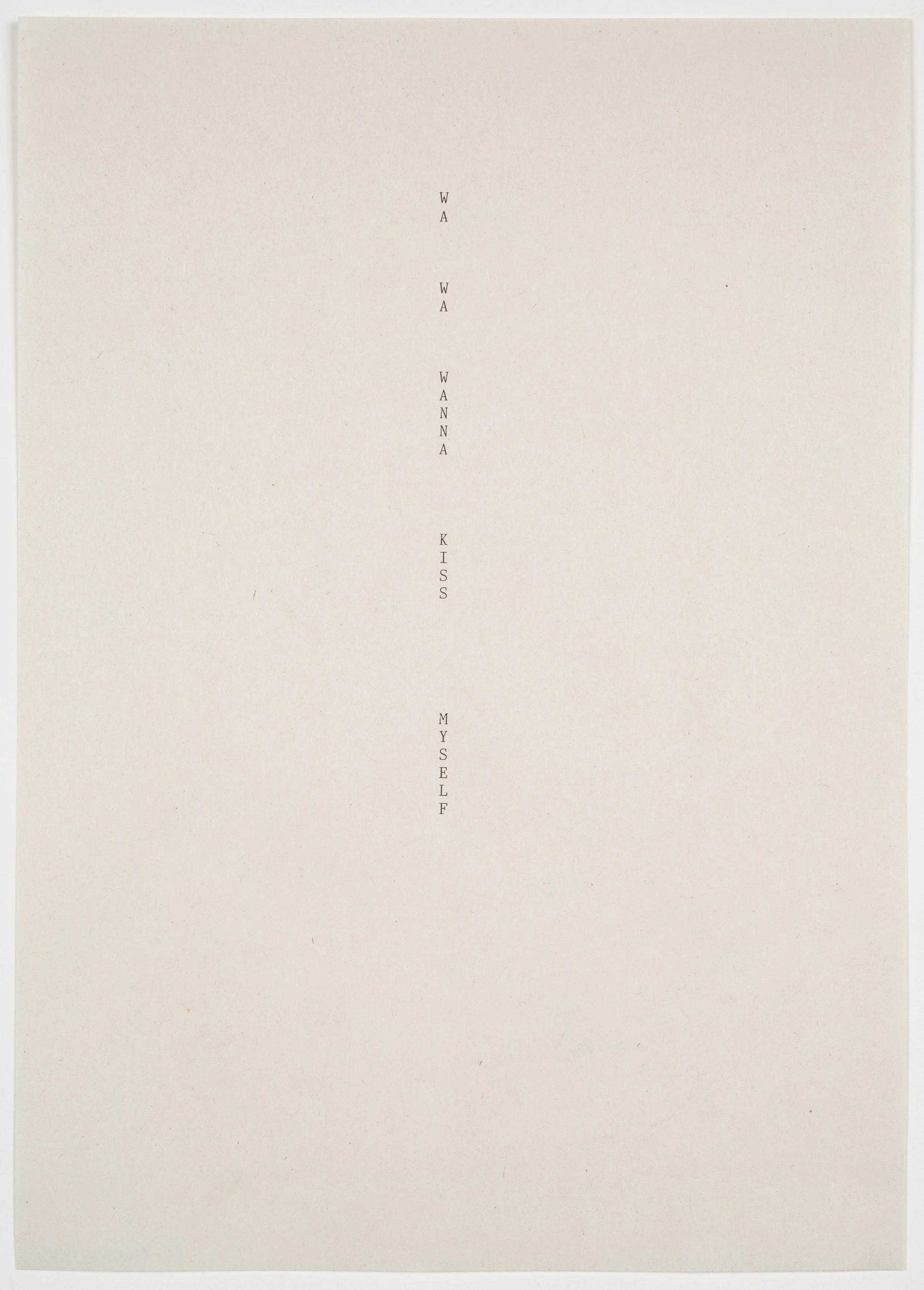
Sue Tompkins, WANNA, 2017. Courtesy of the artist and The Modern Institute/ Toby Webster Ltd., Glasgow. Photo credit: Ruth Clark.
“Language is made not to be believed but to be obeyed, and to compel obedience.”
Deleuze and Guattari, A Thousand Plateaus, 1980
“No details but i’m gonna persuade you, the right stuff, the right stuff, the right stuff, the right stuff…”
Life Without Buildings (Sue Tompkins), PS Exclusive, 2000
Sue Tompkins communicates propositions. Not ideas. Just words.
What are propositional words? Can words function, convince, or compel without intentionality? Can words ever evade intention? Can words be fugitive? What if fugitive words exercised force against their better will? Can gibberish compel obedience? Is repetition by itself enough? What is the ideology of fugitive words? What is the right stuff?
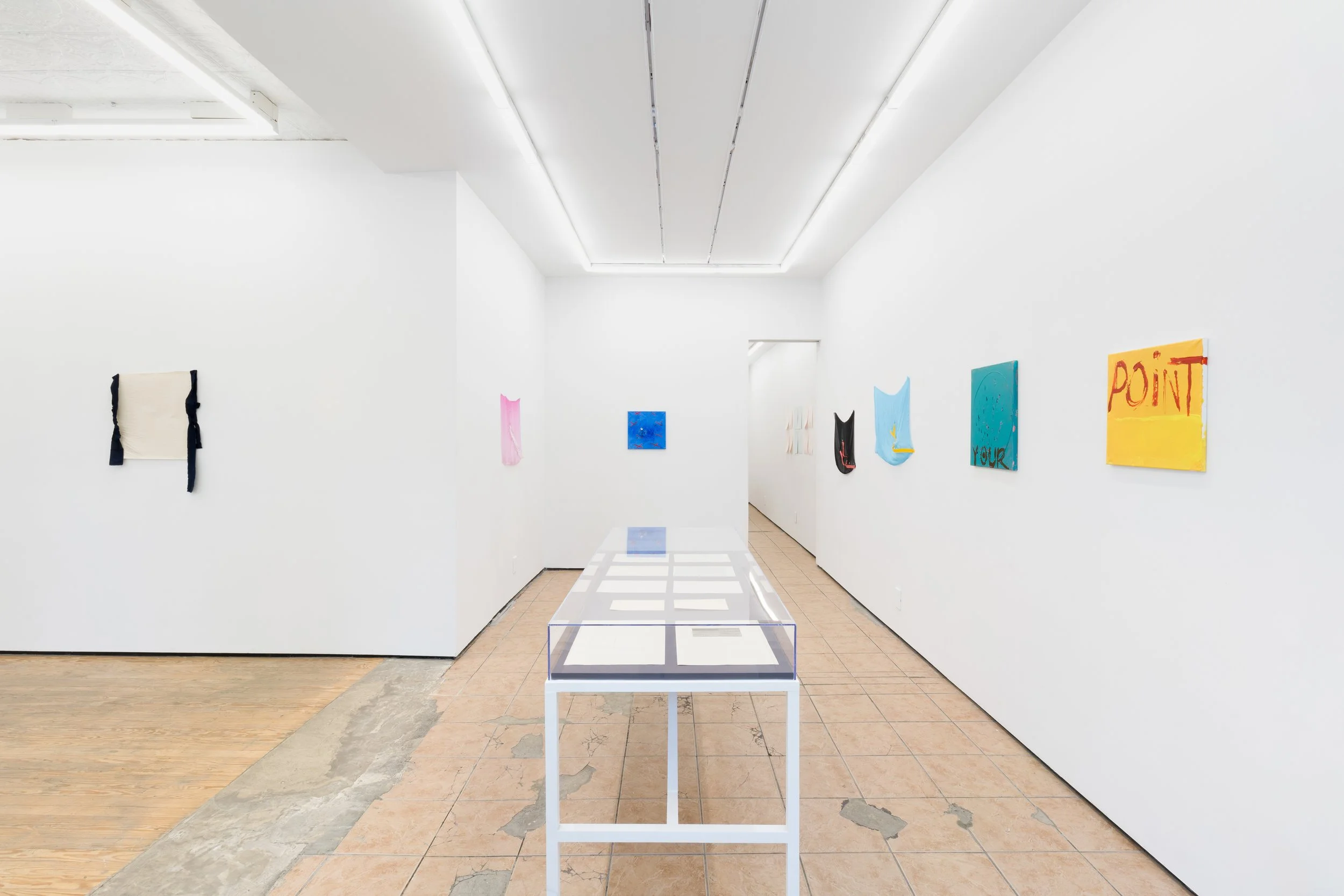
Installation view: Wanna. Courtesy of the artist and King’s Leap, New York. Photo: Stephen Faught.
UK-born artist and rock vocalist Sue Tompkins’ solo exhibition at King’s Leap is a manifesto on words—their suggestion, anatomy, and contours. Its title, Wanna, could not be better suited: a distortion of a turn of phrase offering some proposition left decontextualized.
Do you wanna __________? (fill in the gap).
The text-based paintings, score-like prints, dangling chiffon pieces, and a sound work brought together here all poke at the limits of language with little to no concern for intertextual coherence. It drifts across spheres of knowledge, street vernacular, and pop culture with irreverent disdain for the rational mind. Let me try to rationalize it.
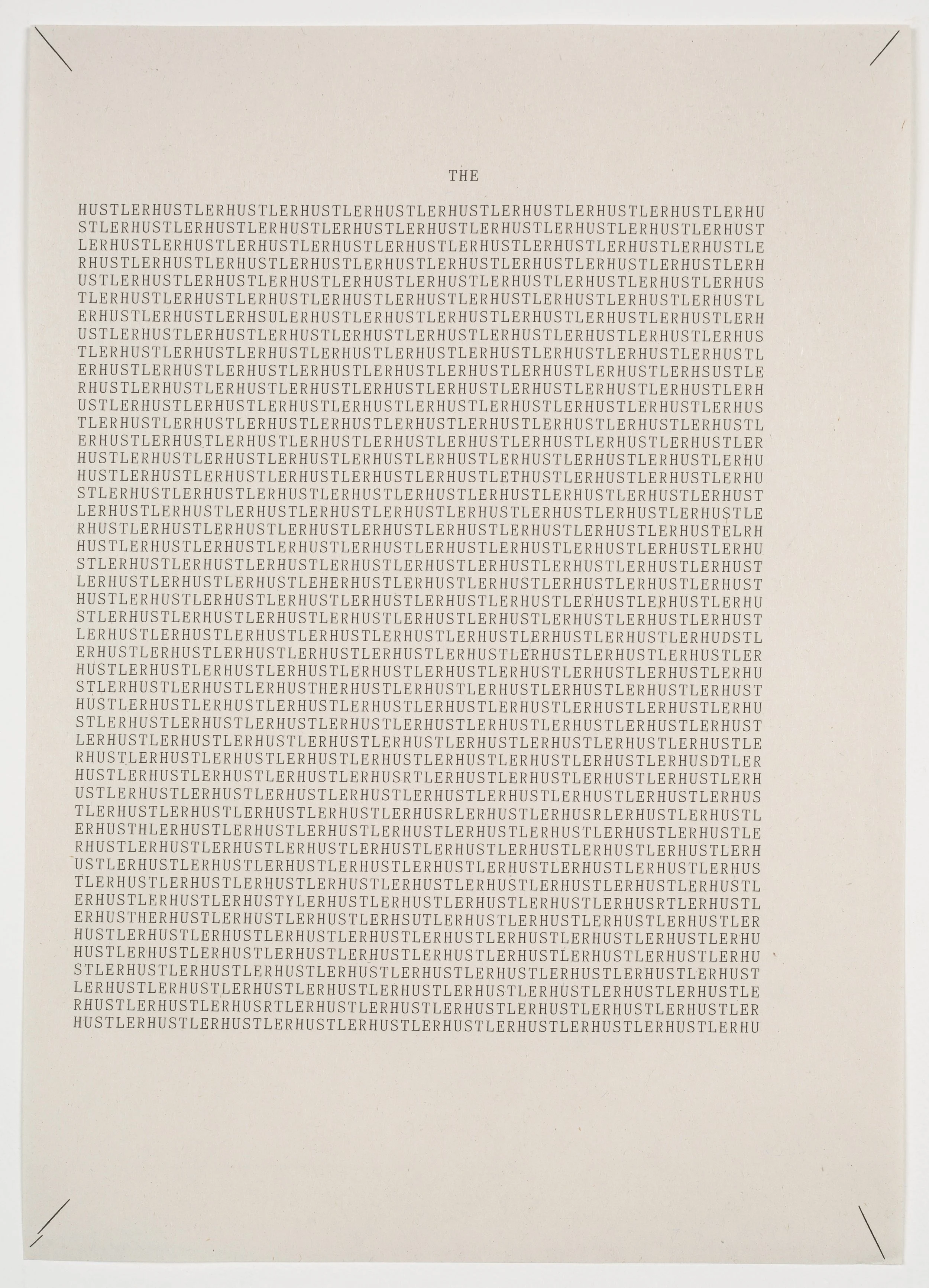
HUSTLER, 2017, Typewritten text on paper 11 3⁄4 × 8 1⁄4 inches (29.7 x 21 cm). Courtesy of The Artist and The Modern Institute/ Toby Webster Ltd., Glasgow. Photo credit: Ruth Clark
Fugitive words are more powerful than you could ever know. This is not a hyperbole. It’s a historical fact.
“Repeat a lie often enough and it becomes truth,” said Nazi propagandist Joseph Goebbels (or Adolf Hitler, depending on who you ask—in fact, the exact quote itself is debated depending on who you ask, but I guess this only enriches my point).
Language is functionally performative. As they enter social reality, words produce, shape, and distort social reality, morphing through repetition and reification, always already escaping truth. (There we meet Deleuze and Guattari.) It doesn’t matter whether you believe words. This process circumvents belief. Receiving words into social reality itself is obedience to their authority, serving the invisible wheel of knowledge production. Their substance, or ideological backbone, is beside the point. Power lies in their deployment and their circulation—in the flow.
We need to talk about Life Without Buildings (1999-2002), the short-lived Glasgow-based indie rock band of which Tompkins was the main vocalist. I bring the band up because there’s arguably no line separating Tompkins’ music, particularly her lyrics, from her visual art—in fact, some of the band’s cover art might as well be a Sue Tompkins print.
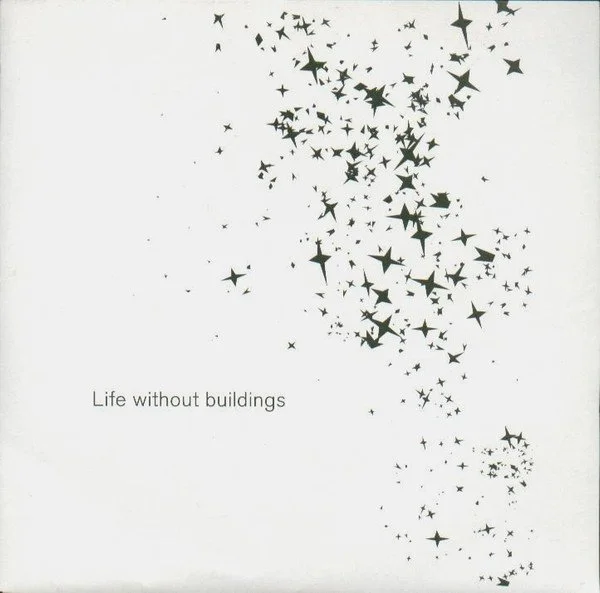
Cover art for the lead singles The Leanover / New Town by Life Without Buildings.
Tompkins’ lyrics entirely reject the emotional transparency of most other indie rock and post-punk outlets. Words here emerge instinctively, with the expressionist spur of a sketch drawing. It’s not only that her work has a musicality to it, but each work seems a blueprint, or score, for something other than itself, as if meant to be completed, performed, or obeyed. The words constellate, forming their own auditory concrete poetry, each vowel and consonant adding a shape and texture, their affect superseding their meaning. The substance evades, but the authority remains.
It’s impossible for me to escape a parallel with Pope.L given his current relevance. Pope.L’s Skin Set drawings, these multimedia works on paper featuring racial generalizations of various real and fictional ethnic groups, offer a compelling counterpoint to Tompkins’ prints. The Skin Sets quite explicitly deal in how the deployment and circulation of words, however meaningless they may be, produce racial categories, and thus, structure the social world. Like Pope.L, Tompkins investigates the flow of language, more than its substance. In an interview, she explains:
I hope that opens up lots of other tangents. Not to muddy things. It’s more positive than mud actually. But I really like mud as well. You know what I mean? Something that isn’t direct. So trying to communicate, then not communicating, then coming back, just the movement and keeping everything active and probable in motion.
Their difference lies in their intentions. Pope.L has a point, or a political edge. Tompkins is pure deployment, pure emergence, pure suggestion: fugitive words, unmediated and directionless. What does this achieve?
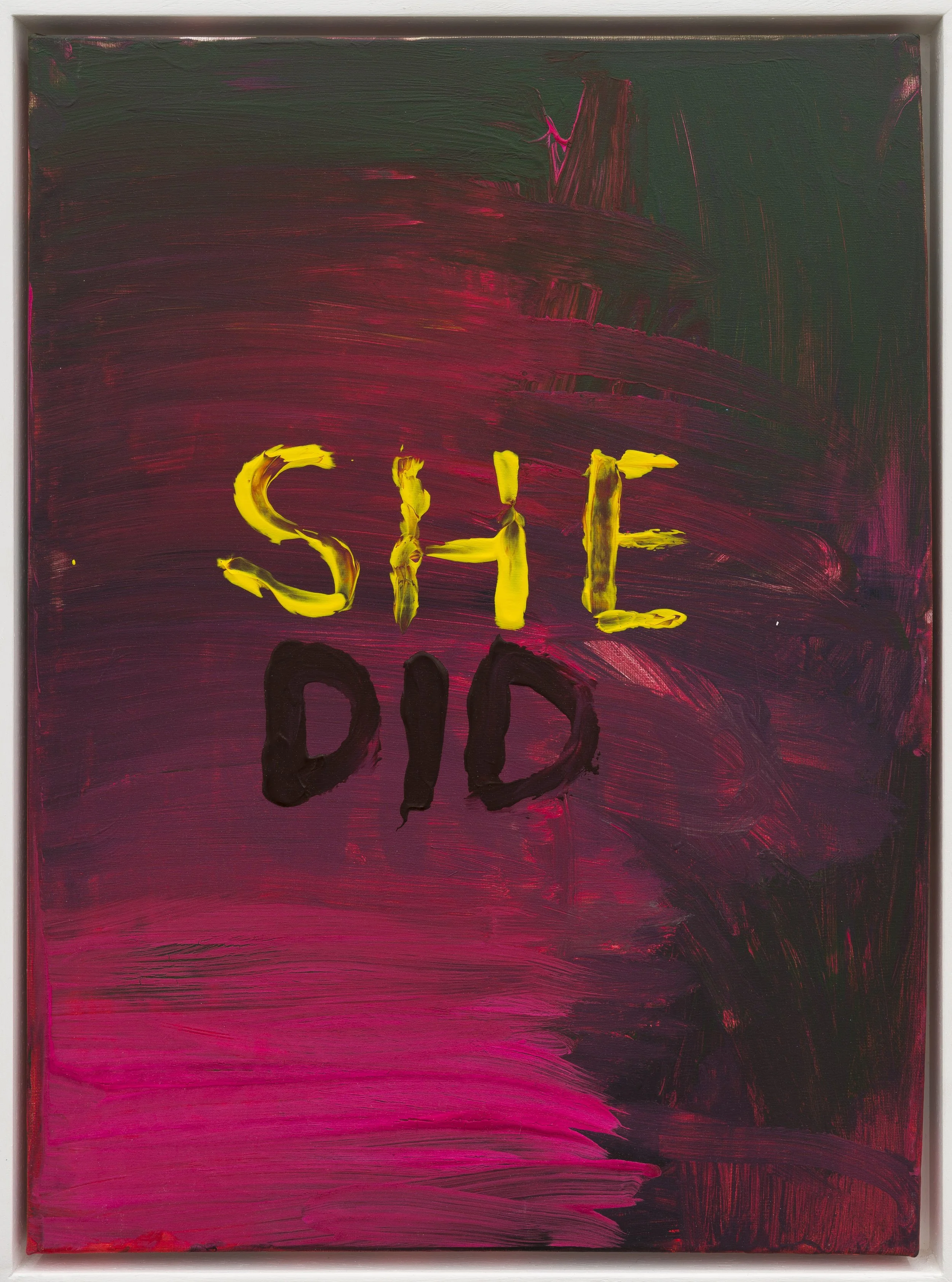
Sue Tompkins, She Did, 2013. Acrylic on canvas, 23 1⁄4 x 17 1⁄4 inches (58.93 x 43.94 cm). Courtesy of the artist and King’s Leap, New York. Photo: Stephen Faught.
As a general rule of thumb, the more suggestive, or score-like, Tompkins gets, the more it works for me. Any time the work becomes legible in any way, some of the magic vanishes.
This is the case with the paintings, featuring neon-painted declarations onto richly layered abstracted fields, such as Your (2014), Man (2015), Get (2013), She Did (2013), etc. As opposed to the prints (we’ll get to them later), the paintings seem self-contained and directional, defined by their color palette, texture, and scale. There are far too many aesthetic choices infusing the words here with some pre-determined affect for them to evade, becoming more of a dialogue or collision between the formal characteristics of the painting and the text on display. In the process, this loses its radical interrogation of language.
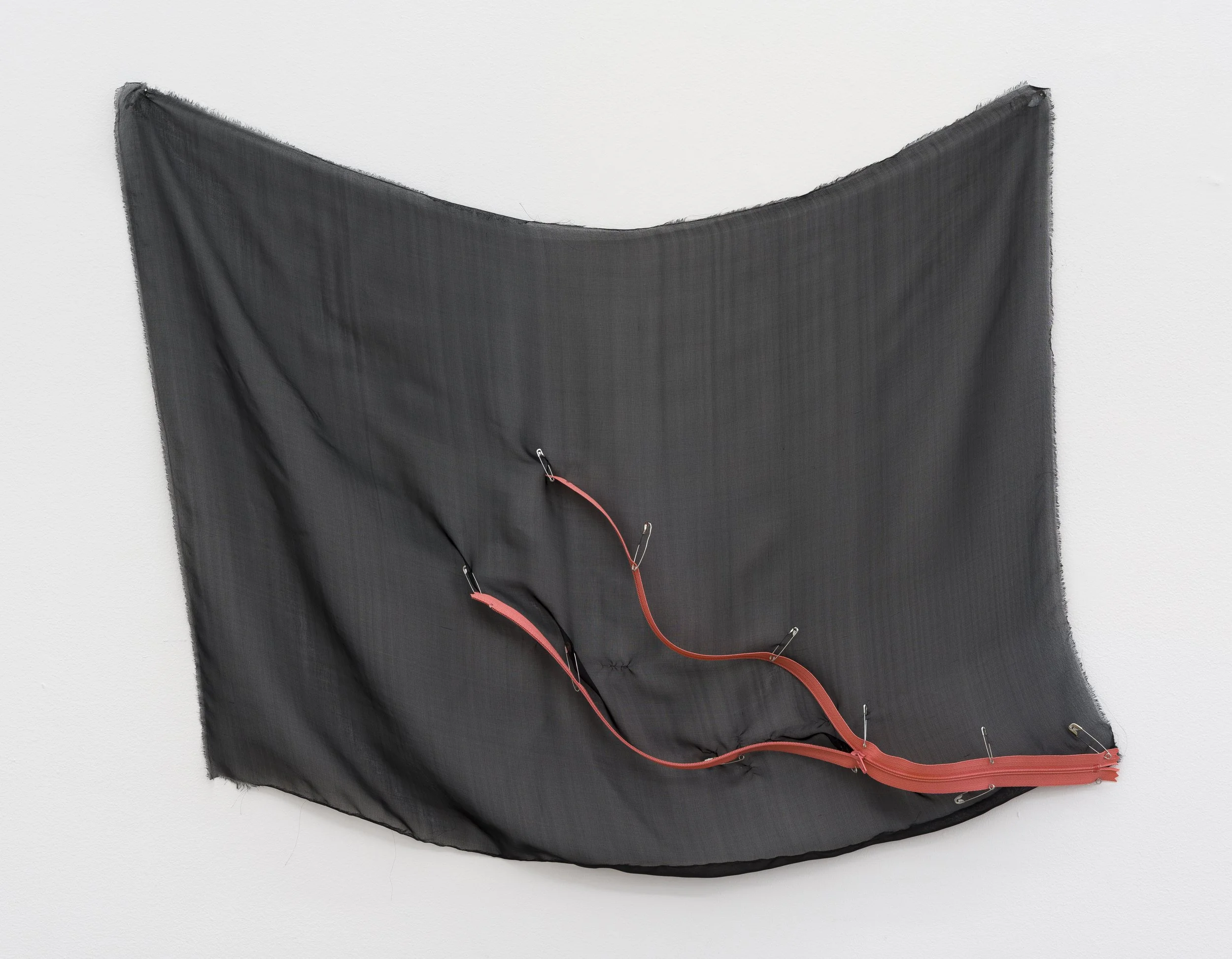
Sue Tompkins, Odyssey Black, 2011. Chiffon, safety pins, zips 20 1⁄2 x 27 1⁄4 inches (52.07 x 69.09 cm). Courtesy of the artist and King’s Leap, New York. Photo: Stephen Faught.
The chiffon pieces, the Odysseys, as they are titled, offer an interesting counterpoint, being the only works in the show with no typography. Dangling from the walls, composed of thin chiffon and zippers held by safety pins, the Odysseys hardly appear confined. They gesture at the deflation of form, meaning, and purpose—in a sense, bringing their own meditation on the dissolution of expression.
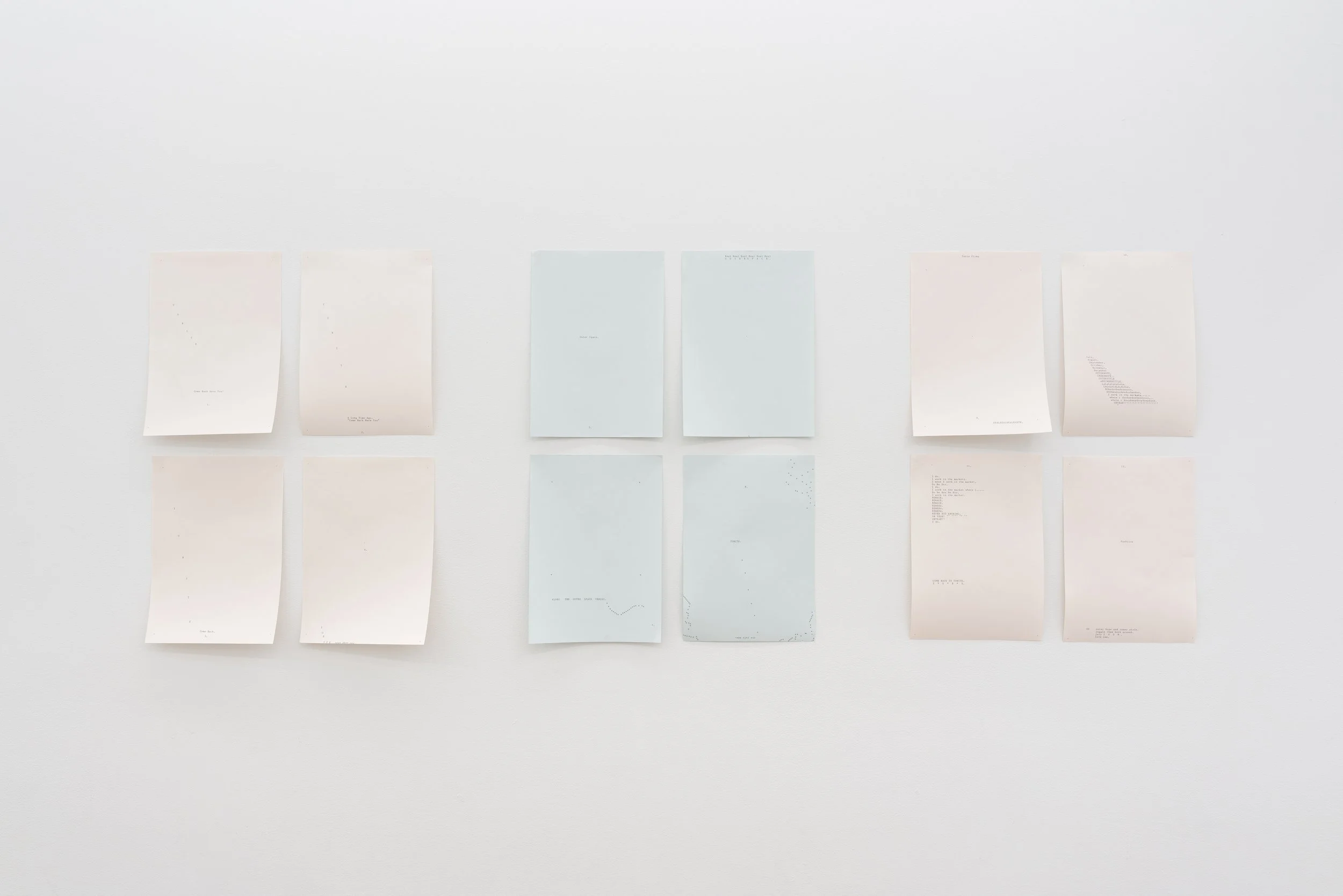
Sue Tompkins, Fashions of Outer Hope and Inner Style, 2009. Courtesy the artist and King’s Leap, New York. Photo: Stephen Faught.
The prints are really the core of the exhibition. They work so well because of their categorical rejection of aesthetic control. Of course, Tompkins can never fully escape aesthetic taste—the shapes, landscapes, and rhythms she creates here are very intentional, and unquestionably beautiful. And yet, they evade containment, always seemingly in search of themselves, existing in continuous flow.
Remember the first line of Life Without Building’s first and only album, Any Other City (2000): “No details but I’m gonna persuade you the right stuff.” This is the guiding principle here. The right stuff is a collection of anti-stories (“I SLIPPED UP IT’S THESE SHOES,” says a print), pop cultural nods, and non-declarations that would rightly belong on an obscure subreddit or a meme page.
The more I sit with the exhibition, the least invested I am in writing this. Words can’t capture what words can’t capture. Words are futile devices. But if words are futile, all words are equal, so utter away freely! It’s fitting that Tompkins’ Instagram page is filled with many of her prints, posted almost daily. It’s a liberating, frankly touching, ritual: an ode to fugitive words circulating in their incompleteness, in futility.
Forget substance. Expression reigns supreme.