
The Campus: A New Locality?
The Campus, which occupies the repurposed Ockawamick School in Claverack, New York, opened its third annual exhibition during a sweltering weekend. In this edition, the six founding New York-based galleries—Bortolami, kurimanzutto, James Cohan, kaufmann repetto, Andrew Kreps, and Anton Kern—expanded their network by collaborating with eight UK galleries, Thomas Dane Gallery, Emalin, Herald St & Gordon Robichaux, Hollybush Gardens, Lisson, Pippy Houldsworth Gallery, Modern Art, and Vigo Gallery.
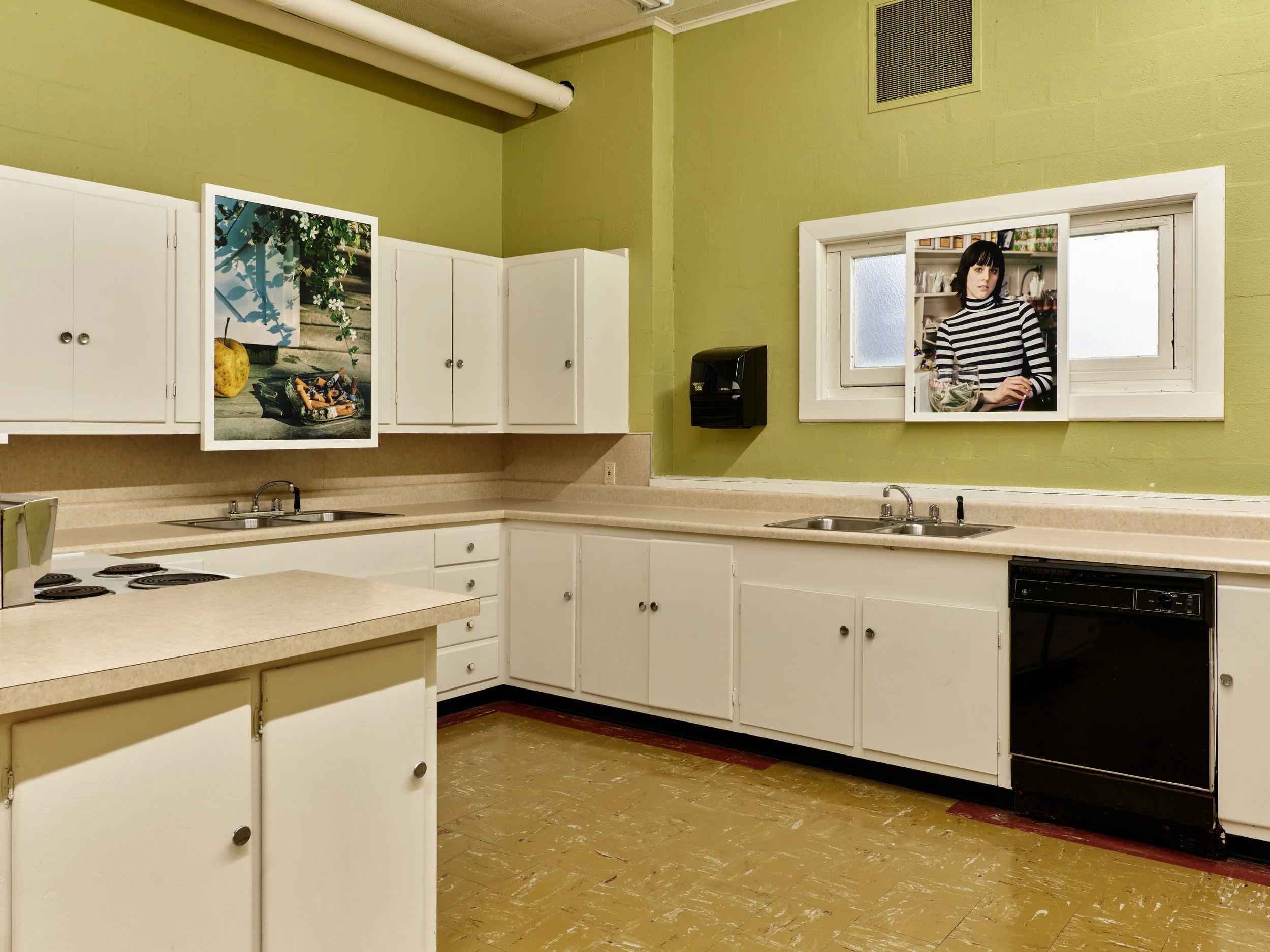
Installation view: The Campus 2026 Annual Exhibition, Hudson, New York, June 27 - November 1, 2026.
Ockawamick School itself bears a storied past as a public school and a private collection showroom. The 78,000-square-foot, one-storey school was built in 1952, as the county’s public schools consolidated from small, spread out one-room schoolhouses to larger ones. After serving local students for over 40 years, the school was abandoned in 1999 and left empty under the ownership of the Columbia County Board of Supervisors from 2008 to 2014.
The six galleries were not the first to repurpose the school as an art space. In 2014, late interior designer and collector Eleanor Ambos bought it to store, repair, and showcase her lifelong collection of art and antiques, with her friend, artist and interior designer Tom Taylor, acting as collection manager and curator. Taylor described his curatorial process in a 2021 interview with Visit Hudson NY, “The caveat was that it should not look like storage, so I had unusually free reign to create fantasy worlds.” (To know more about what the school looked like during Ambos and Taylor’s ownership, see Shannon Greer’s works.) In July 2021, the galleries acquired the school from the Ambos Estate and the first edition of The Campus opened in June 2024. Commenting on the school’s past lives in 2024, James Cohan told Artnet that there are “histories of stuff which we didn’t really know the stories of.” Indeed, nothing in the building today really commemorates the histories of Ockawamick School. Its locality endures as “stuff we didn’t really know the stories of.”
In line with Cohan’s sentiment, The Campus’s third exhibition is expectedly uncanny, like the two previous editions. The press release highlights this exhibition’s “full-room installations…[that] place works in relation to the existing architecture and site history rather than following a specific theme.” I find the disjuncture between the works exhibited and the space—its existing architecture, site history, and room function—alienating. The colorful classroom walls, large glass block windows, and wooden cabinets function as mere eccentric backdrops, adding a midcentury-modern flare. A school’s function of education and community formation, produced through shared acts of looking, questioning, and reflecting, is lost in translation here. The lack of seating, furniture essential for gathering and lingering, feels particularly striking in a school space that was once teeming with it. With only a narrow bench across from Clare Rojas’s The Glowing Night Shade (2022) in the hallway and Max Lamb’s 421 Chairs (2026) at the gymnasium, visitors shuffle through each school room without much time or space for contemplation or communication.
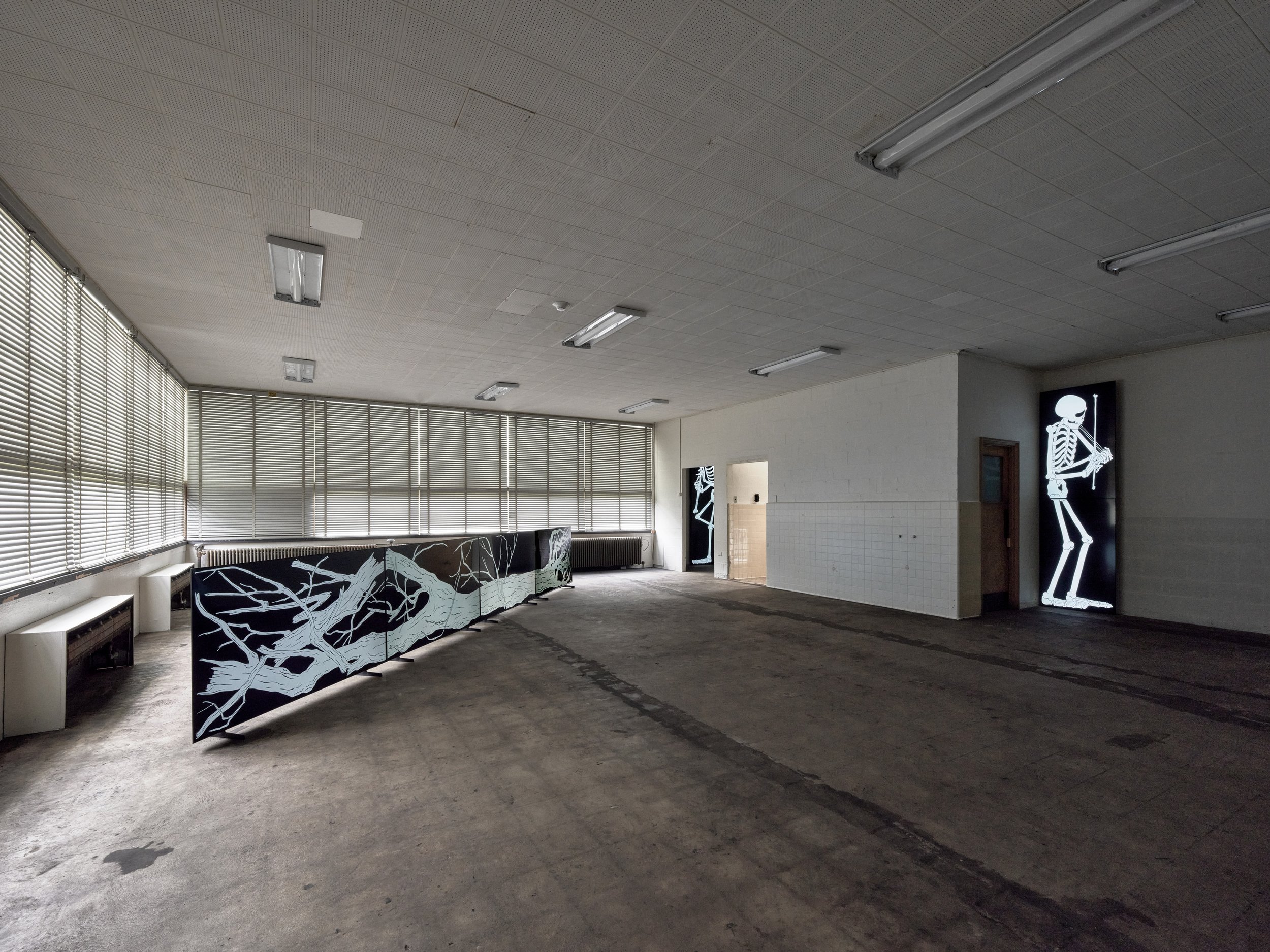
Installation view: The Campus 2026 Annual Exhibition, Hudson, New York, June 27 - November 1, 2026.
A few rooms nonetheless stood out as compelling activations. Turkish-born, Netherlands-based Özgür Kar transforms a large homeroom, its adjoining bathroom, and a closet into a cocoon of dark humor, experienced sculpturally and cinematically. Death Playing The Clarinet (From Dawn) (2023) dwarfs the room, with two large, stacked TV screens showing a skeleton figure playing music instruments in morbid stiffness. Fallen Tree (2023) directly confronts viewers with themes of mortality and decay, as the TV screens spread diagonally across the room while looping animations of a fallen, decaying tree swarmed by insects.
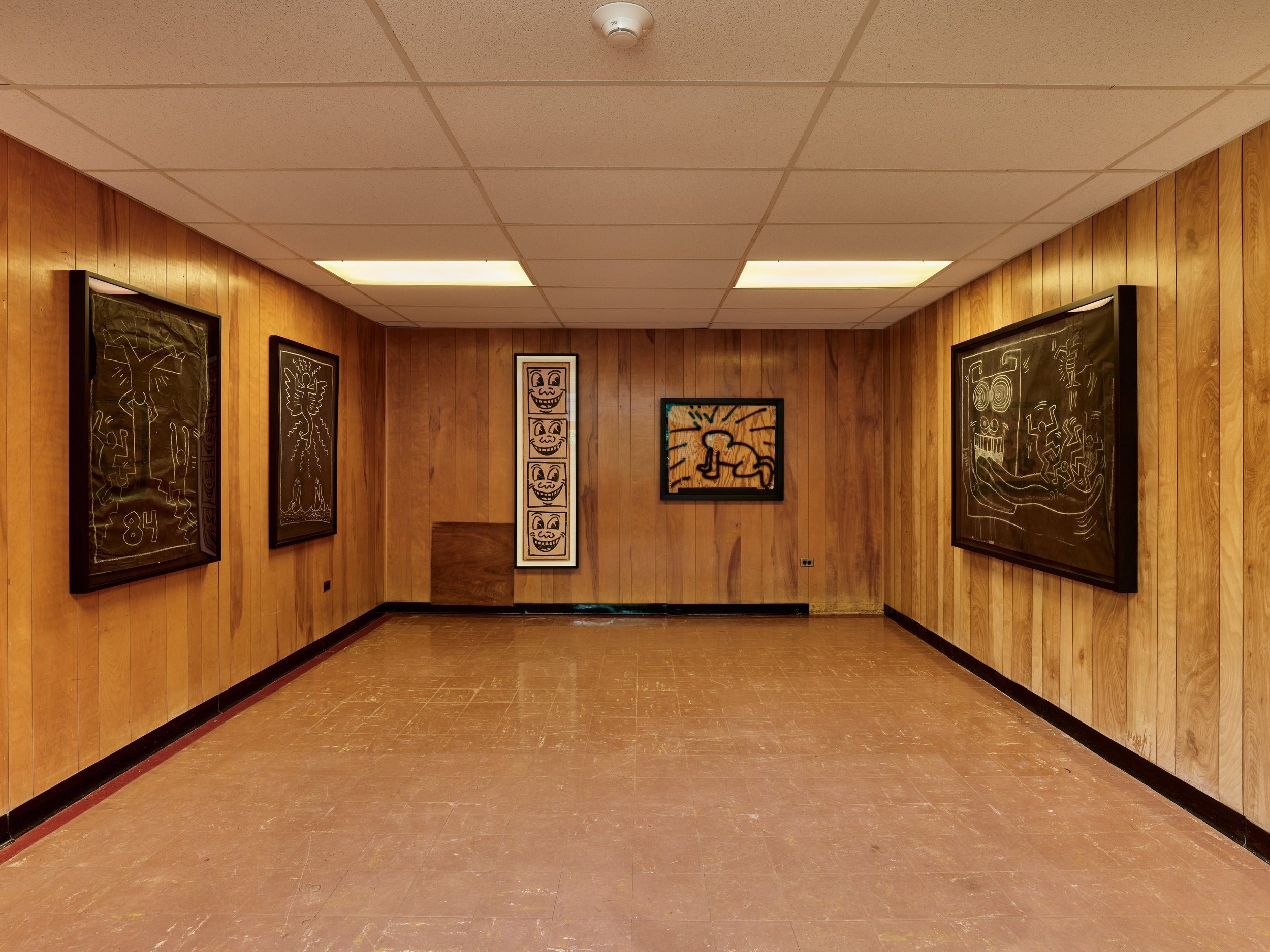
Installation view: The Campus 2026 Annual Exhibition, Hudson, New York, June 27 - November 1, 2026.
Several electric Keith Haring works from the early 1980s flank what was once the principal’s office, enlivening the stern floor-to-ceiling wood panels—a cheeky intervention that Haring would’ve loved. In Untitled (1981/1982), Haring paints four cartoonish, grinning faces on a wooden door found in New York City. Next to it is a graffiti of Haring’s famous design “Radiant Baby,” a crawling child surrounded by radiating lines, spray painted onto a slab of found wood. The spirited, mischievous energy of the grinning faces, the radiant baby, and nearby figures from Haring’s subway chalk drawings resonates with that of the young students who once populated this school. This shared energy activates the surfaces of the wooden walls here as portals, which connect Haring’s New York City streets of the 1980s, Ockawamick School of the late 20th century, and The Campus of today.
In Modernity at Large (1996), anthropologist Arjun Appadurai discusses the production of locality and points out the disjuncture between spatial and virtual neighborhoods produced by electronic media. This disjuncture is precisely present at The Campus, felt between its spatial neighborhood (the many lives of Ockawamick School, particularly the school as a site for education and community formation) and its virtual neighborhood (The Campus as the seasonal art insider destination, circulated via social media posts and sales PDFs). As The Campus seeks to produce a new locality, which Appadurai describes as “a structure of feeling, a property of social life, and an ideology of situated community,” it becomes clear that repurposing the building's architecture alone is not enough to close this disjuncture.
The Campus remains an unfulfilled promise for spatial contiguity, face-to-face links, and artistic activations, but more can and should be done. Closing this gap need not require a complete reinvention of the current model, as The Campus’s collaborative model of mid-size galleries and experimentation with alternative exhibition spaces are undeniably valuable. But as Appadurai reminds us, locality must be ritually sustained and cared for. More thoughtful, sustained public programming and architectural interventions that nod to the building's storied past could go a long way.