
Pauline Curnier Jardin Speaks in Tongues
The expression “speaking in tongues” (or glossolalia) refers to a state of spiritual trance, historically associated with the Pentecostal Church, in which the overwhelmed, sometimes possessed, soul expresses itself through indecipherable languages. It appears as direct communication with the divine, transcending the limits of rationality and language, and testifies to a profound emotional and mystical intensity.
Pauline Curnier Jardin, view of the exhibition "Virages Vierges", Palais de Tokyo, 2026. Photo credit: Aurélien Mole. Courtesy of the artist, Ellen de Bruijne Projects (Amsterdam) & ChertLüdde (Berlin) © Adagp, Paris, 2026.
Working at the crossroads of installation, performance, film, and drawing, Marseille-born artist Pauline Curnier Jardin conjures immersive cinematic universes where baroque excess meets mythology, religion, folklore, and carnival. Her practice unfolds as a gathering, a reunion of characters and rituals that intermingle to untangle languages, intertwine them, or invent new ones. Sometimes we taste. Sometimes we scream. Sometimes we recite. Sometimes we lick. And sometimes we grimace. Language then becomes a sacred organ, an instrument and metaphor, a site where desire, power, and disobedience converge.
Efforts to discipline the female voice, long misconstrued as an unruly form of expression, extend beyond a mere exercise of control. Pauline Curnier Jardin strives to deconstruct stereotypical representations, particularly of women, by opening new imaginaries where all reversals are possible.
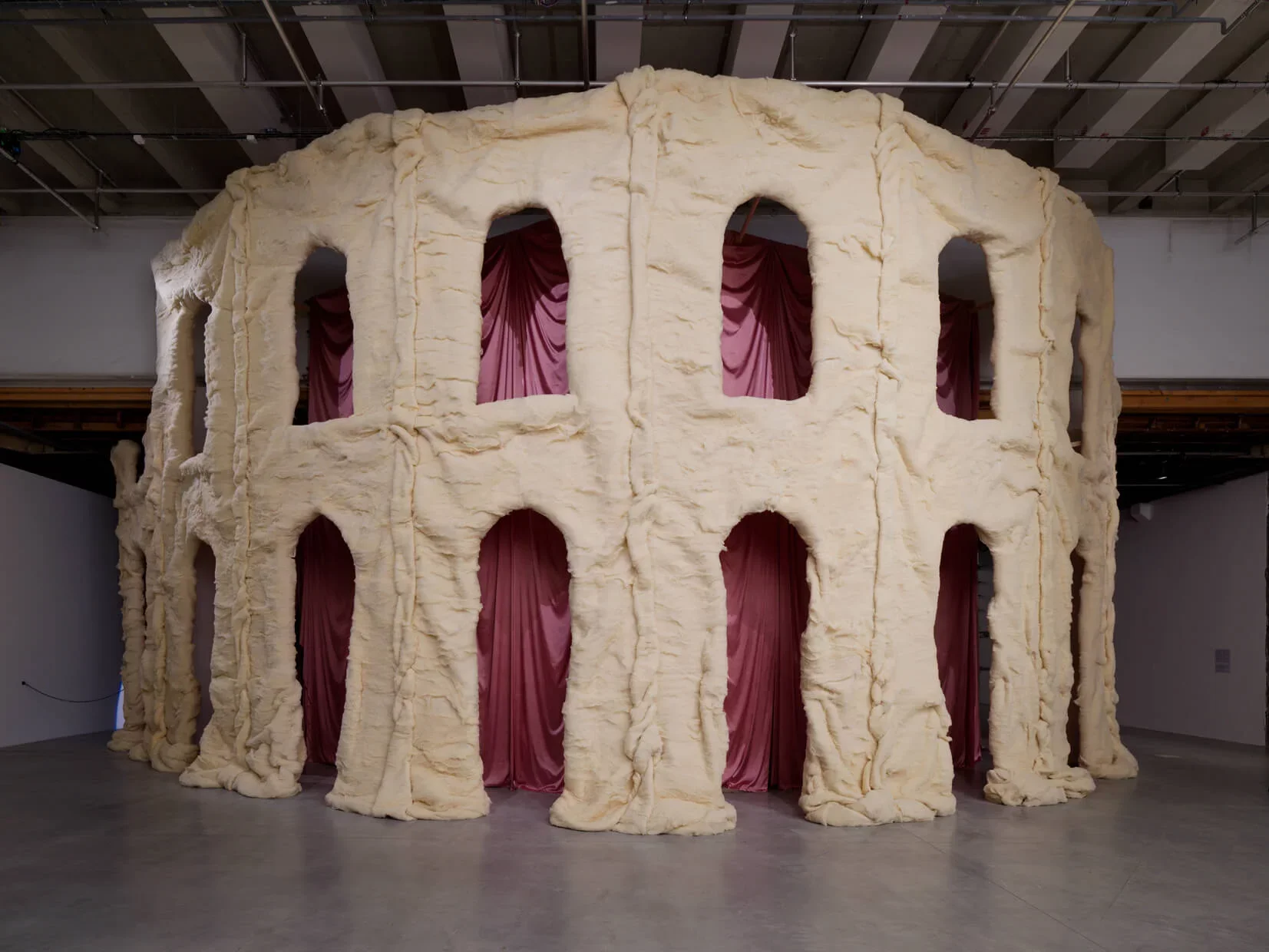
In her video Fat to Ashes (2021), the artist fuses three scenarios in a spasmodic, disorderly manner: a religious festival in honor of Saint Agatha in southern Italy, the slaughter of a pig, and the Cologne Carnival. The video is projected inside an imposing, vast arena that resembles a fluffy cake made of marzipan. Situated between Rome’s Colosseum and a theatrical set, the structure echoes the landscape in which the artist grew up, near the arenas of Arles and Nîmes.
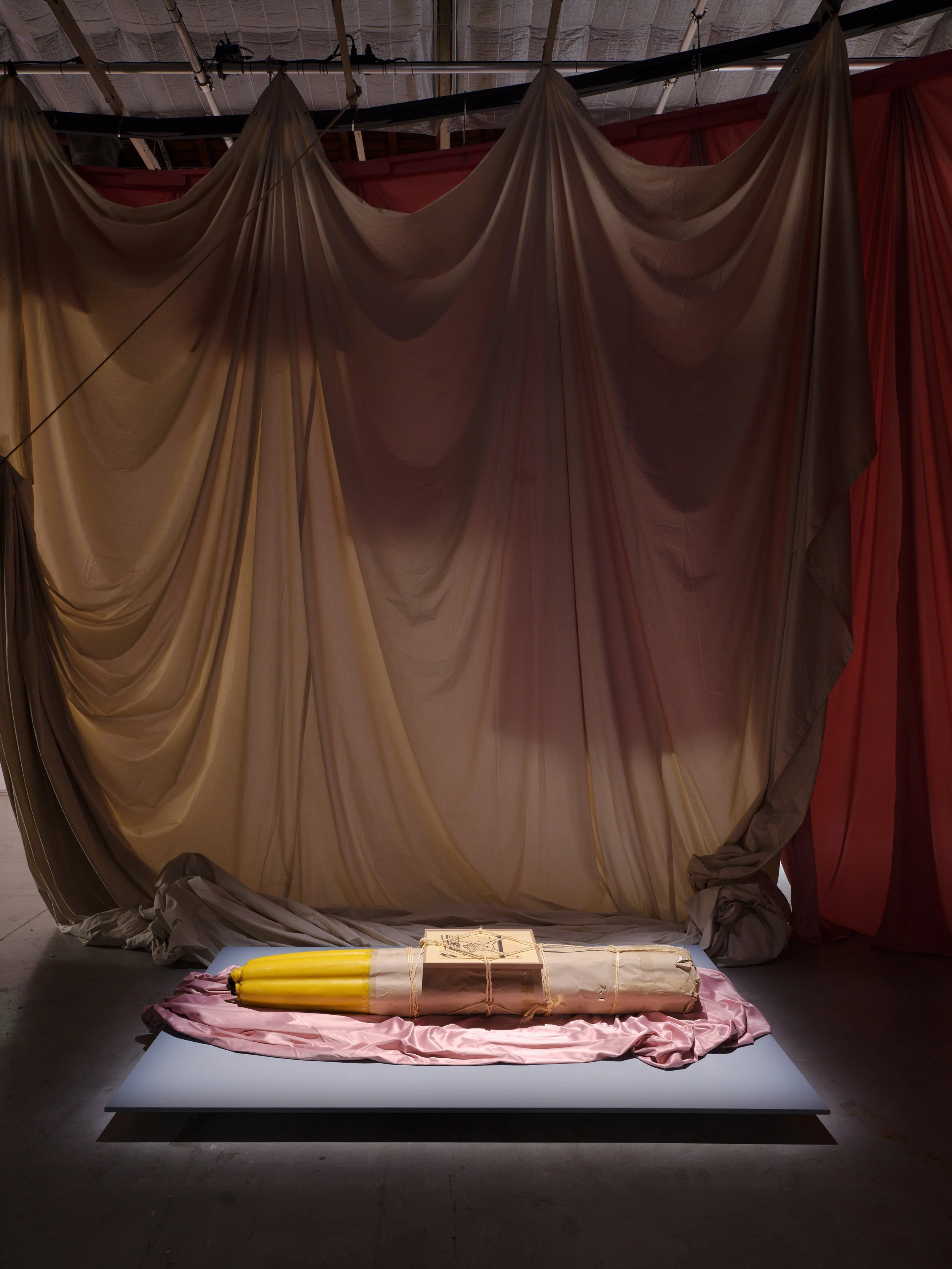
Candles are scattered around the arena like liturgical relics. Once held high in processions honoring saints and martyrs, they now rest in a state of suspension. The installation also features a long candle attached to an erotic drawing from a series created by the Feel Good Cooperative, a collective founded by the artist during the pandemic bringing together sex workers and their allies. Initially, Curnier Jardin acquired the sex workers’ drawings in exchange for the cost of a sexual service, an encounter that later developed into a long-term artistic collaboration.
Curnier Jardin also references the tale of Hansel and Gretel, a story steeped in violence and cannibalism. Lured by a house built of sweets in the heart of the forest, the titular children only manage to escape the witch who wanted to devour them by throwing her into the oven themselves. Curnier Jardin raises a disturbing question: once the witch is cooked, will the children be tempted to eat her in turn? [1]
The arena, taking on the shape of a wedding cake, acts here as a mockery of this masculinist tradition, of the architecture of power that underlies it. [2] But the sweet, sugary façade evokes the seductive dimension of this bloody spectacle. It draws us in, provoking a desire to watch, to taste, to immerse ourselves. It is therefore in this context that the spectator is invited to take a seat in the arena’s stands.
Pauline Curnier Jardin, view of the exhibition "Virages Vierges", Palais de Tokyo, 2026. Photo credit: Aurélien Mole. Courtesy of the artist, Ellen de Bruijne Projects (Amsterdam) & ChertLüdde (Berlin) © Adagp, Paris, 2026.
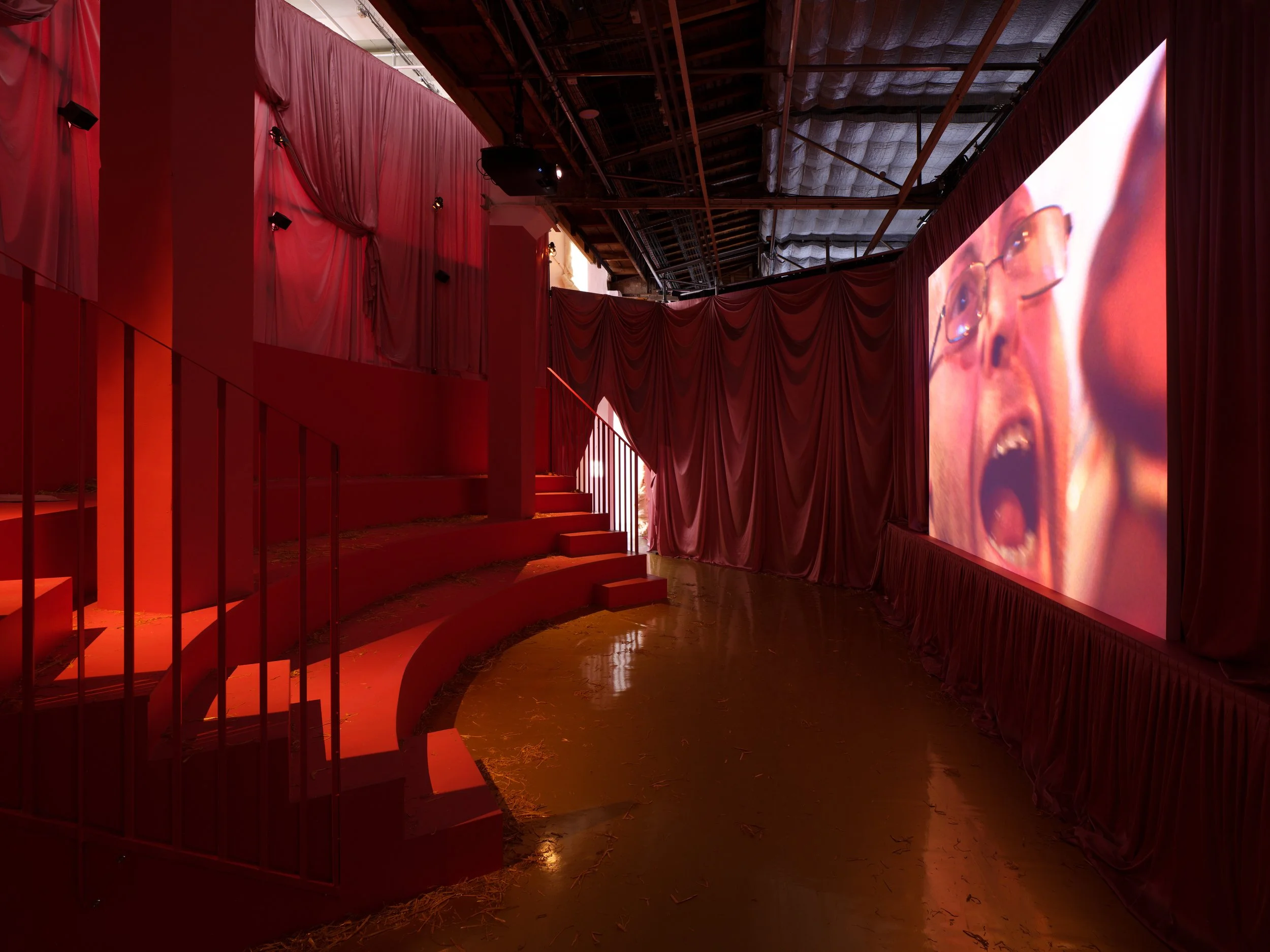
The video installation Fat to Ashes documents, among other things, the annual procession of Saint Agatha in Catania, Sicily during which the people of Catania miraculously invoke to protect against eruptions of Mount Etna. Through this celebration, the video also traces the history of the saint herself: a third-century martyr, a noble Christian maiden tortured for refusing the advances of Prefect Quintianus.
Mirroring this biblical narrative, Curnier Jardin intertwines brutality and desire. Scenes of violence mingle with moments of intimacy and sensuality. The soundtrack intensifies this experience: prayers shouted hysterically, a mouth filmed in close-up, crossing the frame’s boundaries and shattering the fourth wall. Relics of the saint, putti carrying her breasts on a silver platter, and a woman with a bloodied chest punctuate the pictorial space, opening the sacred dimension. A female voice solemnly recites a prayer: “The suffering you will inflict on me will be short-lived and I look forward to experiencing it,” confronting the viewer with the unsettling proximity between suffering, desire, and consent. Children, dressed in religious garb, simulate female mutilation in an almost playful manner, while a participant from the Cologne Carnival — which we will examine later — displays an inscription painted in red on the back of his shirt: “Dr. José Fellatio, breast enlargement by the laying on of hands.”
In this carnivalesque and grotesque hubbub, the preparation of cassateddi di Sant’Agata, minni di Sant’Agata, or minnuzzi (“little breasts”) in Sicilian dialect becomes both a tribute to Saint Agatha’s martyrdom and a frenzied celebration of gluttony.
But why do Sicilians eat Agatha? Why do they associate this dessert with the death and dismemberment of saints?
These small pastries, despite their harmless appearance, are “edible icons of sadomasochism,” according to historian Cristina Mazzoni. [3] The glorious body is anesthetized into a cake that can be touched and devoured. These Sicilian pastries, shaped like breasts and made of ricotta and marzipan topped with a red cherry, function as an edible ritual, a cannibalistic license serving some devotional function. creating a divide between what is deemed civilized and uncivilized. The Festival of Saint Agatha thus transforms the breast into sugar, agony into delicacy, horror into joy.
Film clips show a pig being butchered, a nod to Rembrandt’s The Slaughtered Ox (1655). Between the Feast of Saint Agatha and the Cologne Carnival in Germany, this is the only purely literal gesture in Curnier Jardin’s work, intended to highlight the materiality of flesh and blood. The camera, much like the word “carnival,” derived from carnelevare (“the removal of meat”), draws our attention to a pig destined for slaughter, evoking the original meaning of the word, carne. [4]
What is nevertheless worth noting is that, historically, the bodies of martyrs were intended for the beasts with which they shared the amphitheater. A recurring narrative pattern in the Bible, whenever the motif of the martyr as flesh delivered to the animals is evoked, is the beasts rejecting human food delivered to them, not for lack of appetite but because, unlike humans, they recognize the sanctity of the martyred body. [5] This is notably the case with Saint Blandine, a young Christian woman martyred in Lyon in the second century, typically depicted tied up in an arena, surrounded by lions. Thus, in Curnier Jardin’s work, the sequence shots of the pig alongside those of Saint Agatha blend symbolic and narrative elements, offering a warning: no one can recognize the Holy Spirit anymore. The world has been consumed by debauchery.
The work then highlights scenes from the Cologne Carnival, which begins around November 11 but culminates in the week leading up to Ash Wednesday. Extravagant costumes, colorful parades, and traditional songs create a joyful, festive atmosphere. Rosenmontag is the highlight of the week, with satirical floats and candy thrown into the streets. [6]
What initially drove the artist to record the carnival was observing Weiberfastnacht, the women’s carnival, which marks the start of street festivities where women cut off men’s ties and kiss whomever they please, as if to emasculate them. Yet the filming of the carnival was haunted from the start, as production began the day after the 2020 Hanau massacre. A man had killed nine people in and around two bars, followed by his mother, before taking his own life. The carnival nonetheless began thereafter. [7]
Fat to Ashes then captures the gradual appearance of men costumed as figures of authority: soldiers, police officers, or city officials. Transgression is no longer possible. No one mocks the law. On the contrary, everyone seems to want to embody it. The Cologne Carnival has nothing in common with Weiberfastnacht.
A group of smiling gospel singers in blackface appears on screen. The racist gesture, combined with their gospel costumes and their performance of “Oh Happy Day” amidst young police officers. The story of the carnival unfolds in an unsettled zone of ambiguity, where the smiles and laughter of a joyful celebration conceal the scars of systemic racism, homophobia, and misogyny.
Finally, these three intertwined,fragmented scenes—the Feast of Saint Agatha, the butchered pig, and the Cologne Carnival—generate transformation of meaning. Through these excerpts, the artist anatomizes the origins of the violence embedded in European patriarchal culture. [8] She also highlights how desire can be constructed from this violence inflicted on bodies, while questioning our reactions to these images.
Pauline Curnier Jardin, view of the exhibition "Virages Vierges", Palais de Tokyo, 2026. Photo credit: Aurélien Mole. Courtesy of the artist, Ellen de Bruijne Projects (Amsterdam) & ChertLüdde (Berlin) © Adagp, Paris, 2026.
Pauline Curnier Jardin’s work draws us into the lion’s den. We are inside the mouth, eating, grinding our teeth, screaming, kissing frantically. The arena becomes a voracious space where tongues become gladiators, intertwine and twist, where stories merge, and where cultures and narratives fuse, at the heart of a gargantuan, indigestible banquet. How can we distinguish truth from falsehood when everything collides and swirls at the back of the throat before being forcefully spat out? Fat to Ashes speaks to us in an unknowable language, an incomprehensible incantation that nevertheless manages to communicate something. Human flesh melts and becomes icing. Blood mixes with wax, becomes greasy, viscous, then solid, then the candles are blown out in the rush of the party. And only ashes remain.
Curnier Jardin, Pauline, Fat to Ashes, Hamburger Bahnhof Berlin, 2022
Curnier Jardin, Pauline, Fat to Ashes, Hamburger Bahnhof Berlin, 2022
Gasparini, V, et al., editors. Lived Religion in the Ancient Mediterranean World: Approaching Religious Transformations from Archaeology, History and Classics, De Gruyter, 2020.
Curnier Jardin, Pauline, Fat to Ashes, Hamburger Bahnhof Berlin, 2022.
Gasparini, V, et al., editors. Lived Religion in the Ancient Mediterranean World: Approaching Religious Transformations from Archaeology, History and Classics, De Gruyter, 2020.
Gasparini, V, et al., editors. Lived Religion in the Ancient Mediterranean World: Approaching Religious Transformations from Archaeology, History and Classics, De Gruyter, 2020.
Curnier Jardin, Pauline, Fat to Ashes, Hamburger Bahnhof Berlin, 2022.
Curnier Jardin, Pauline, Fat to Ashes, Hamburger Bahnhof Berlin, 2022.