
David Altmejd: Psychic Surgery
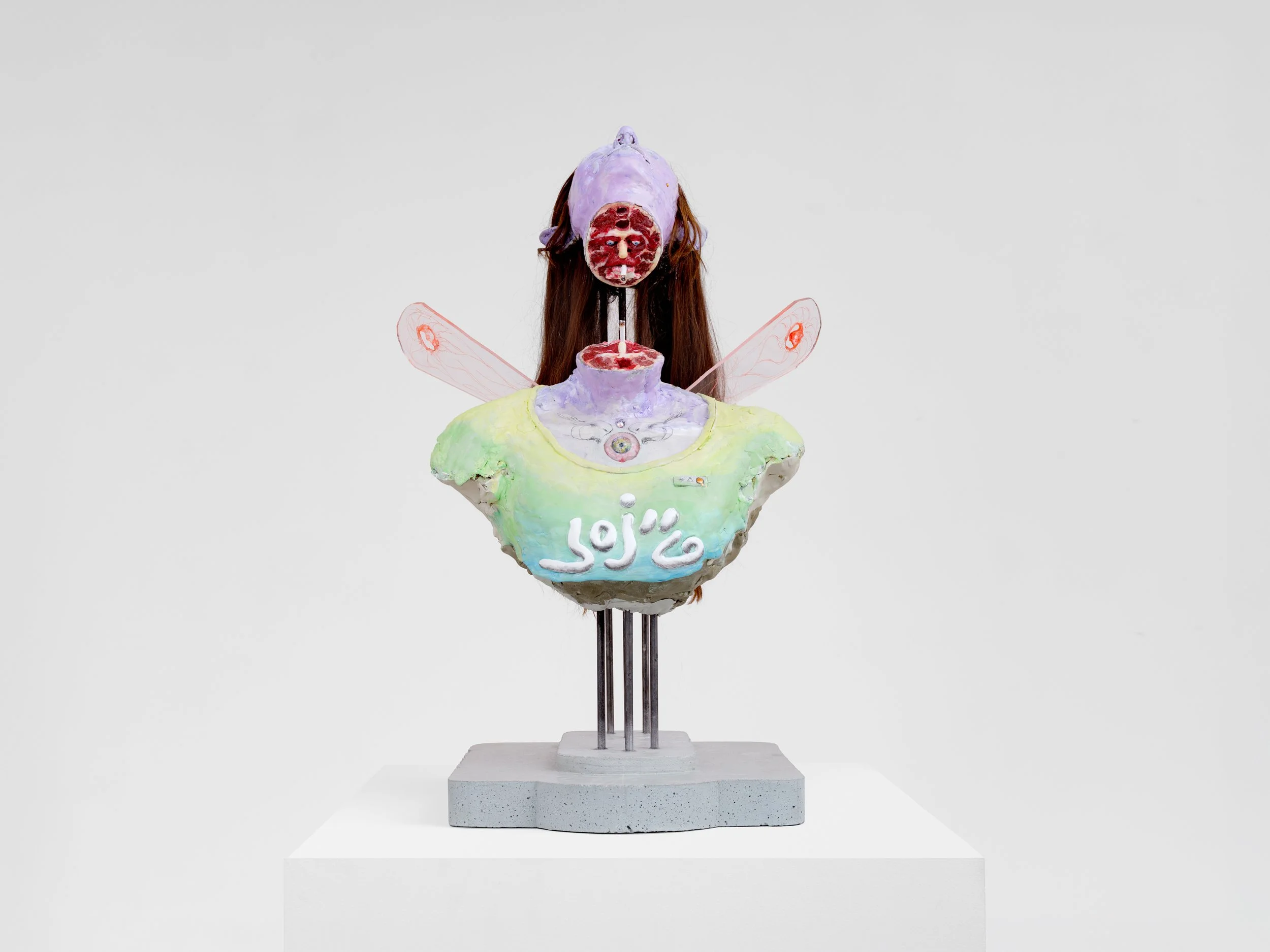
David Altmejd, Smoking with Oneself, 2021-2026. Expandable foam, epoxy clay, epoxy gel, resin, hair, acrylic paint, quartz, pencil, Plexiglas, paper, thread, metal wire, glass rhinestones, steel rods, and concrete, 35.5 × 21.5 × 20.5 in. Courtesy of the artist, David Kordansky Gallery, Los Angeles, and Management, New York. -Photo by Inna Svyatsky/installshots.art
The figure reflects the torso of a woman, looking back with her throat cut open. Synthetic materials (expandable foam, epoxy clay, epoxy gel, and resin) perform as the raw flesh exposing the inside of her throat. Past her fairy wings and long hair, a face emerges from the flesh: two eyes, a nose, and a mouth holding a cigarette. A second cigarette protrudes from her neck, still attached to her torso. Curtained behind the thick hair, the back of the skull is hollow and filled with crystals. She’s held up by steel rods, which take on the role bones usually would. She seems caught mid-transformation, somewhere between being assembled and falling apart.
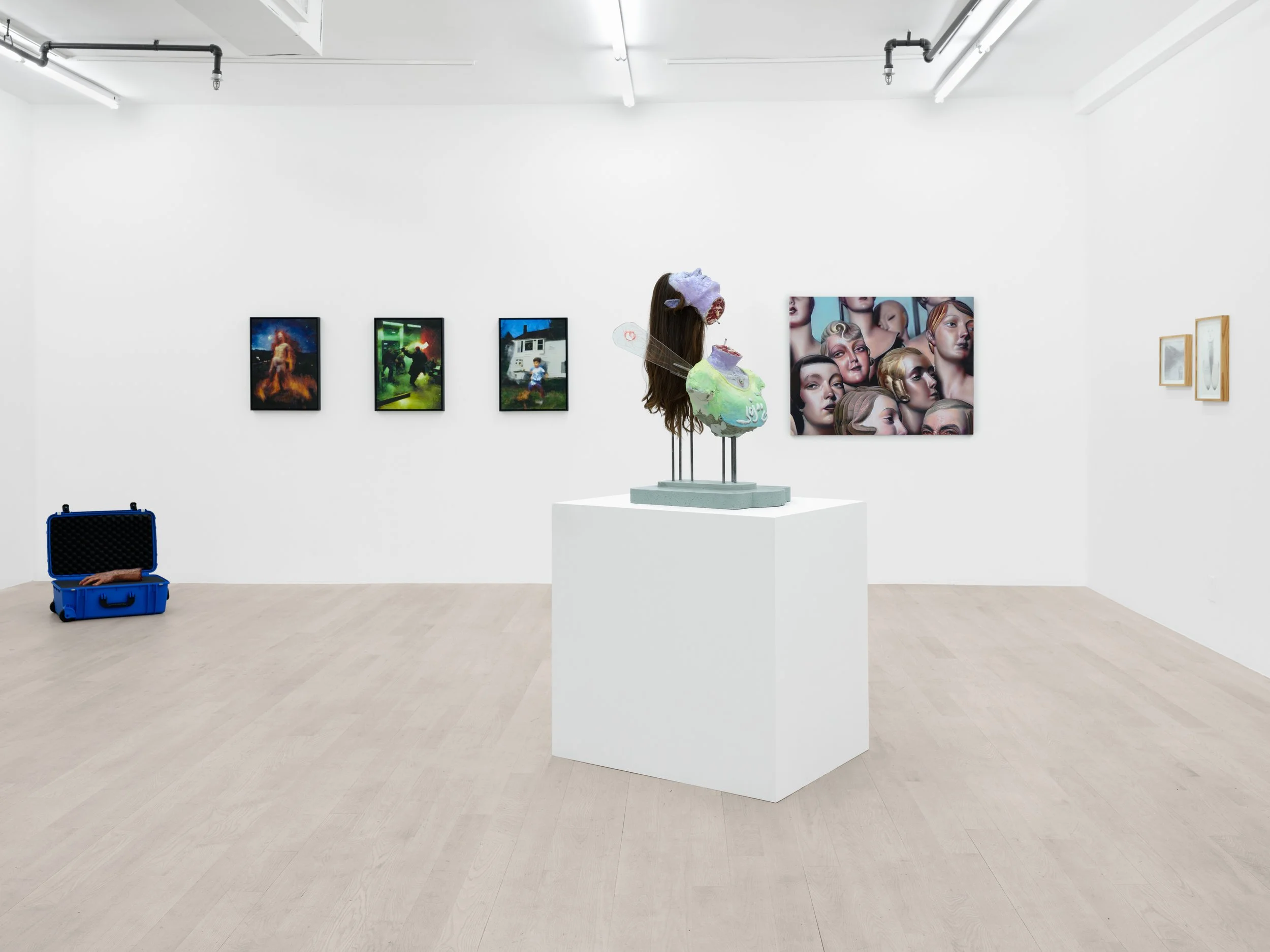
New Grotesque, 2026, installation view. Courtesy of Management, New York. Photography by Inna Svyatsky/installshots.art
I find comfort in the unsettling. Discomfort, to me, is a ritual of introspection. Art that breaches my boundaries of comfort reveal something about myself that I didn’t know before. That’s why I was so intrigued by New Grotesque at Management, a group exhibition that re-examines the nature of the grotesque genre. Every work is designed to induce discomfort within the space, from Aleksandra Waliszewska’s intrusive and unsettling paintings—a woman whose smile doesn't reach her eyes, a face erupting in red, a figure crawling out of a doorway in the corner of the frame––to Andrew Roberts’ arm inside a hard case. But David Altmejd’s Smoking with Oneself (2021–2026), the show’s centerpiece, is the one that truly got under my skin.
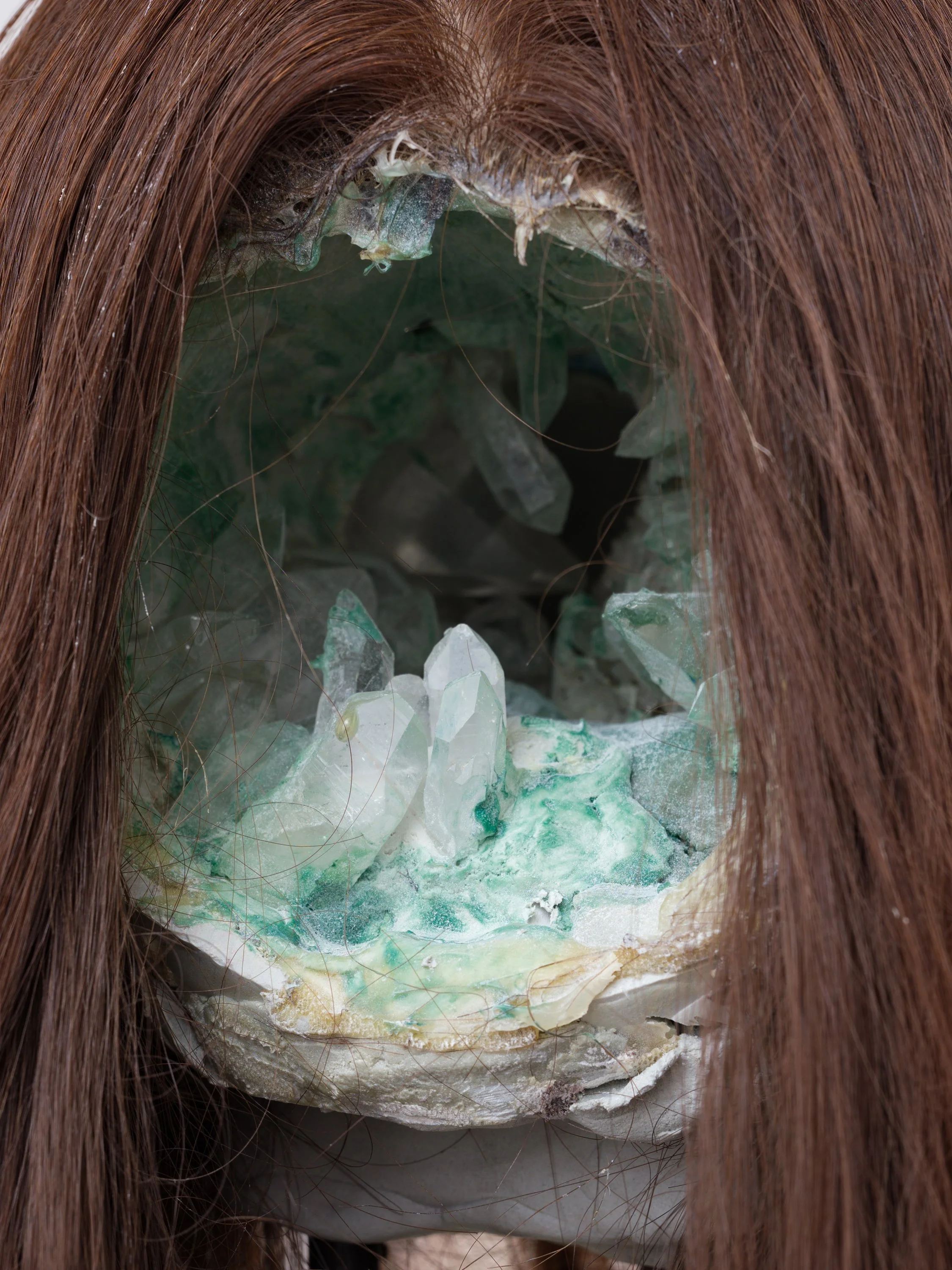
David Altmejd, Smoking with Oneself, 2021-2026.
It was hard to focus on anything else but her. As I circled around it—my soft footsteps echoing in the small, quiet gallery on the fourth floor of the Chinatown building—I recalled that scene from Annihilation (2018) where the protagonist is being mirrored by an alien-like cosmic entity that copies her exact movements and mannerisms to the point where we, the viewers, can’t tell them apart. Anthropomorphic sculptures have always made me feel uncomfortable. They produce that uncanny feeling that automatically makes me wary of them but also compels me to look inward—to understand what that unease reveals about me.
While two-dimensional works offer the comfort of distance—you can contemplate them from the safety of pictorial separation—sculpture occupies your space and breathes your oxygen. Their fabricated humanness gives them a familiar feel, but they are usually different enough to feel off. In Das Unheimliche (1919), Sigmund Freud argues that “the double," or doppelgänger, is among the archetype of the uncanny: a figure that arises, according to folklore, to protect against death and ends up the very thing we dread. The concept of doppelgängers is deeply ingrained in pop culture today, from its place in Gothic literature, with works such as Robert Louis Stevenson’s Dr. Jekyll and Mr. Hyde (1886), to its many iterations in contemporary cinema and TV, such as in David Lynch's Twin Peaks (1990–1991). They are narrative devices used in psychological horror to destabilize the fragile sense of stability we take for granted. An attack on the self and its foundations.
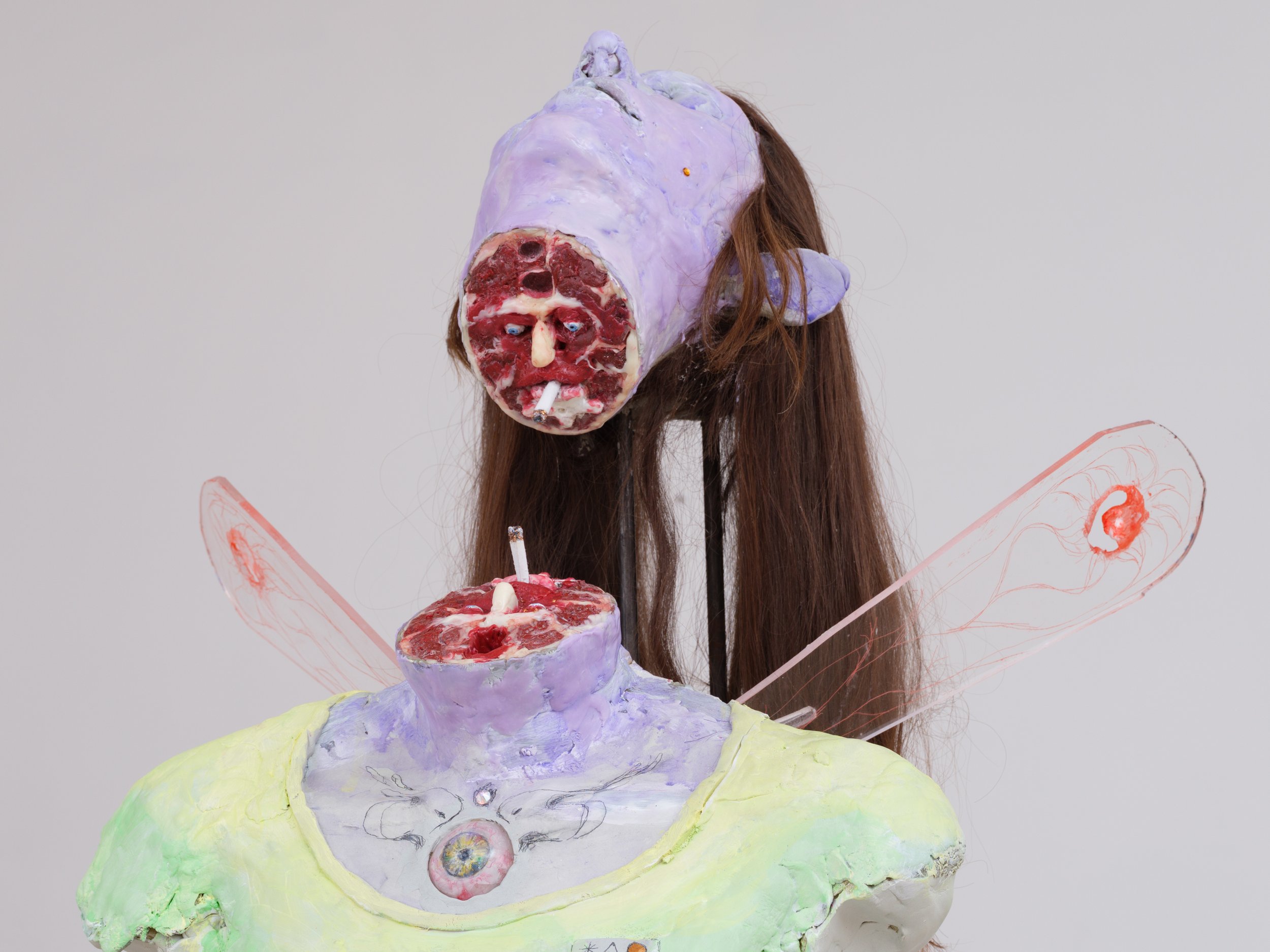
David Altmejd, Smoking with Oneself, 2021-2026.
Looking at Smoking with Oneself, I felt disgust at the alluring vibrancy and tenderness of the exposed flesh and unease not only at the grotesque view of the dismembered body but also at its disconcerting familiarity. Two beings that exist within the body: one wounded, the other emerging. The entity emerging from the neck doesn’t appear hostile. It doesn’t even seem to be aware of its host. Similar to Annihilation's shimmer––the extraterrestrial biological phenomenon that refracts and mutates all living organisms it encounters—the entity is just there, sharing the body, completely indifferent to the violence it’s caused in order to exist.
As someone with OCD, I understand what it is to inhabit a mind that often feels shared with, or subsumed by, something other than itself. It's a constant negotiation with an entity that feels both intrinsic and alien to my mind. That's why I’ve always hated the expression "trust your gut.” My gut has never existed on its own. It’s always been split between a part that is trying to move through the world and another that is constantly sabotaging that. Neither fully trusts the other.
Altmejd once said he wants to bring out the most grotesque things for everyone to see. He looks at decay not as a loss but as a vessel for something new—decay breeds regeneration. That’s why Smoking with Oneself resonated so deeply with me. Standing before it, the work exposed meIt burned my throat as if I were the woman cut open for everyone to see—my flesh, my insides, and my insecurities. It disturbs me to see myself reflected in the grotesque, but this is the ritual I keep returning to. I don’t intend to find resolution, but I do hope to embrace that self-recognition. Altmejd’s work gives me that, and the unease that comes with it.