Aruni Dharmakirthi: Growth, as a Stream

Aruni Dharmakirthia, MindStream II (detail), 2026. Courtesy of artist and TEMPEST.
Doctor: What are you doing here, honey? You're not even old enough to know how bad life gets.
Cecilia: Obviously, Doctor, you've never been a 13-year-old girl.
from The Virgin Suicides (2001), written and directed by Sofia Coppola
In The Order of Time (2017), Carlo Rovelli writes that “the world is not a collection of things, [but] a collection of events” (98). Although geology, mineralogy, chemistry, and physics may tempt us to see a stone as a thing, it is not. The universe knows better. Within the span of the universe, a stone is an event, with a durational lifespan: it emerges, erodes, and vanishes, its growth always relational to external forces. Everything operates like this, in the everflow of transformation, in a constant state of becoming, interconnected and recursive.
Just as we like to attribute thingness to events, we find comfort in thinking of growth in stages. Character growth is after all the crux of most narratives throughout history. The hero’s journey, as Joseph Campbell called it: that process of traversing the unknown parts of the self and returning to oneself, now changed. Campbell is open to relationality, to the belief that encounters with that which is external to the self is what changes the self. But there is a scientific romanticism and a reductive circularity to his framework.
You and I know: growth is rarely ever rational, directed, or complete.
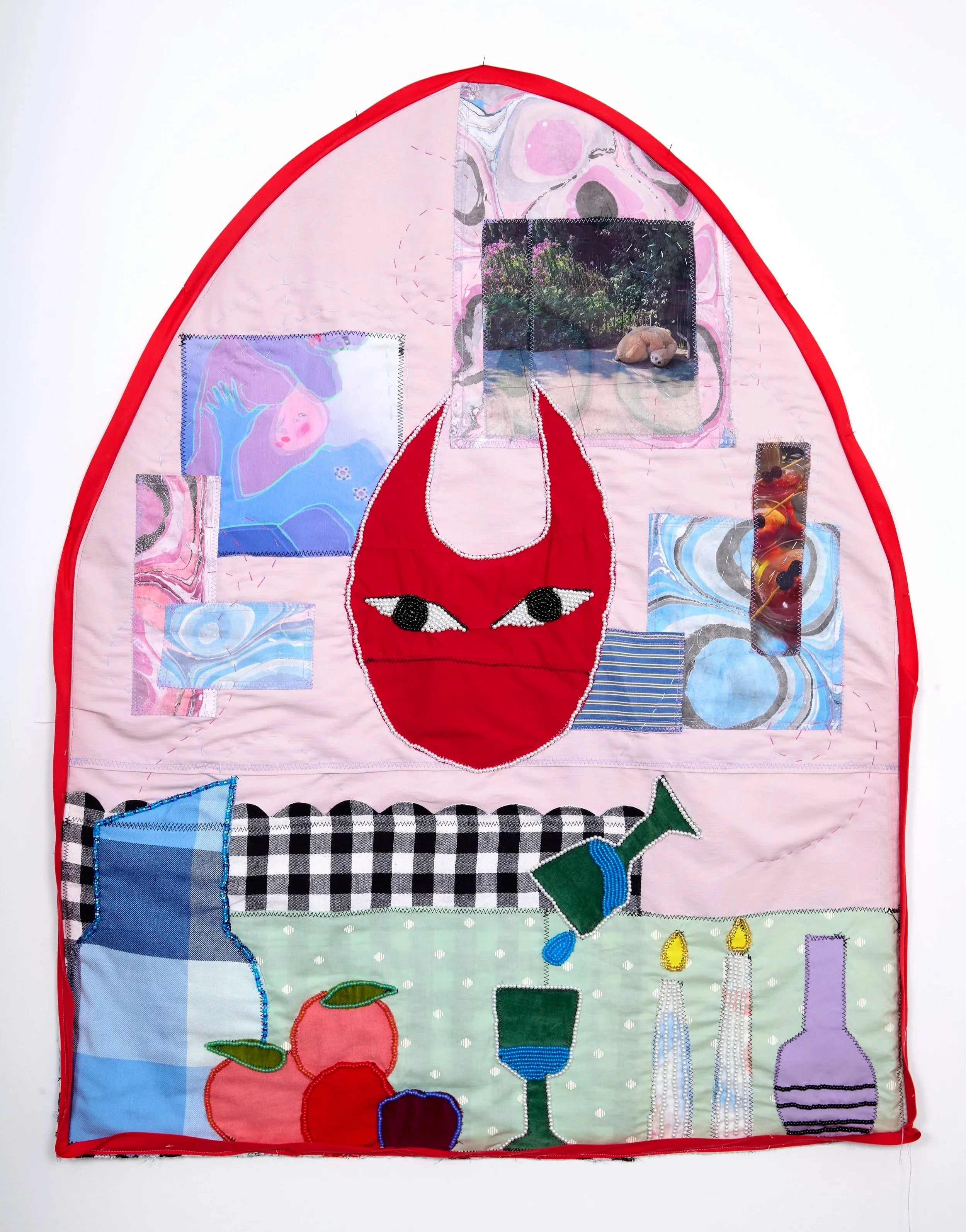
Aruni Dharmakirthia, Portrait of Iblis: The Fallen Angel, 2026. Courtesy of artist and TEMPEST.
As she started her reflections on the meaning of growth, Aruni Dharmakirthi turned to the coming of age story. Today, we might associate the coming of age with contemporary rom-coms, where a non-descript couple must undergo third act hardship, a climactic breakthrough, to learn the true nature of love. Or sometimes, it is about a lost young adult finding fulfillment in life through a meandering series of events. But what if the coming of age originated much earlier?
The fallen angel Iblis became an obsession for Aruni. Iblis who lived in harmony with goodness and graced by God’s love falls from the kingdom of heaven to become Satan due to heartbreak. Lovelessness turns him into an agent of evil. Iblis is the archetype of heartbreak. And yet, it would be wrong to suggest that he never came of age. His roots grew. They just grew downward, toward the depths of hell.
Aruni also turned to Sophia, sometimes believed to be the central figure of The Thunder, Perfect Mind (c. 235 CE), a Coptic language text originally discovered in the Nag Hammadi library in 1945. As the story goes, the goddess Sophia creates the world by accident. She falls and her body fractures into the million pieces making up our world and our people. We are — and everything around us is — Sophia.
What of growth that sprouts from happenstance? What of Sophia’s fragmentation or the Big-Bang? Can the accidental not be meaningful?
In her search, Aruni found that growth is a recursive process, incessantly leaping across time and unraveled by the resurfacings of memories, fantasies, and mythologies. Growth is not a line, but a black hole.
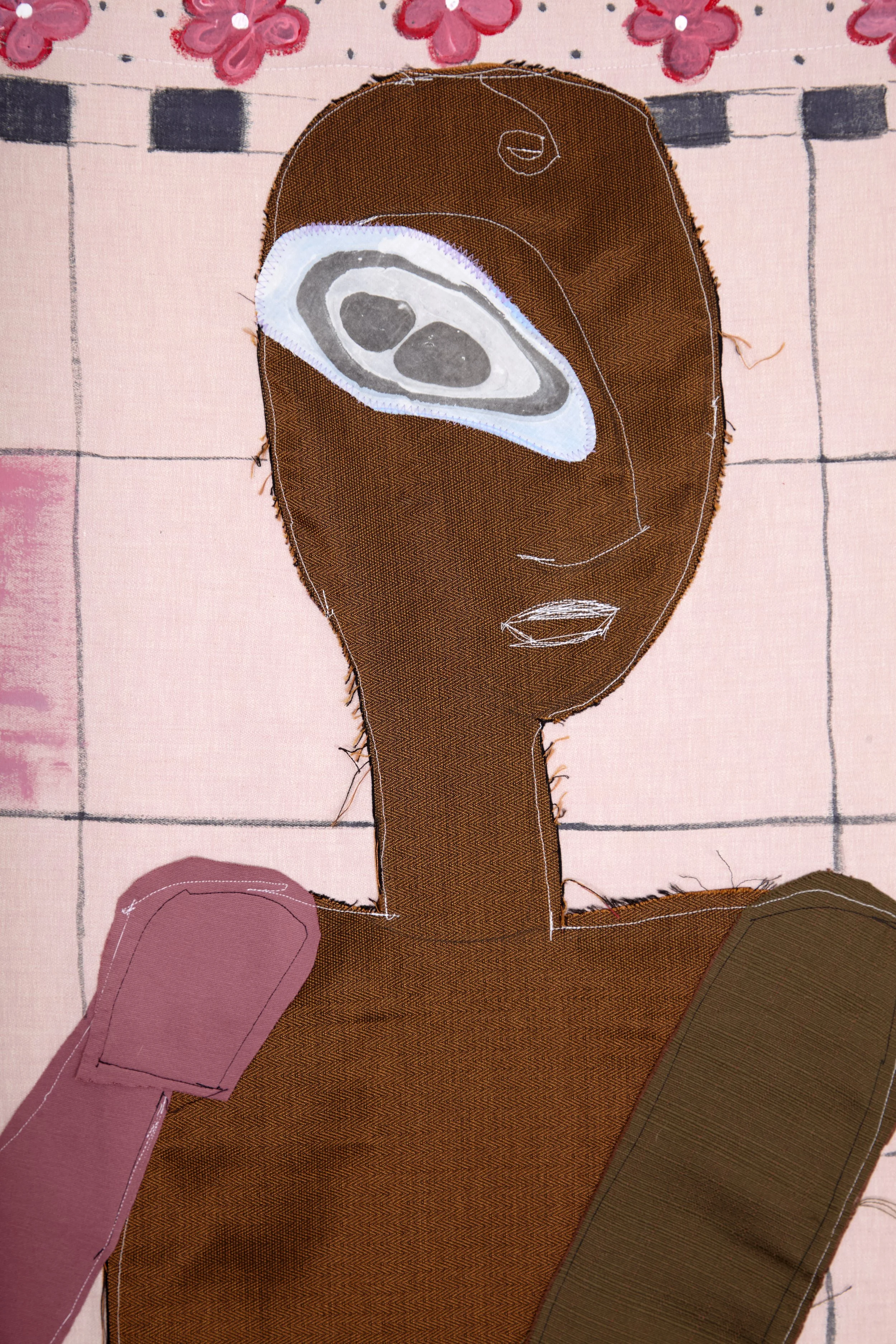
Aruni Dharmakirthia, Sleepwalker (detail), 2026. Courtesy of artist and TEMPEST.
The World Is A Kiss, Not A Stone finds Aruni exploring the webs of growth. Her tapestries collage religious iconographies, scrapbook drawings, pop cultural homages, and the everyday archive of her iPhone camera, situating the here and elsewhere, past and present, real and imaginary as interdependent fields in constant flux. These are magical realist diaristic tapestries, where myth unfolds alongside everyday life. Each work is a page from a personal mythology that embraces the fluidity of identity formation and memory. Rather than narrative logic, these visions are steeped in contradictions around belonging, spirituality, and desire, reflecting Dharmakirthi’s lived experience as a Sri Lankan immigrant living in the United States. Yet despite their specificity, her works are universally inviting and familiar, like the disarming sight of a childhood blanket.
These are shapes, figures, textures you’ve seen before, perhaps in passing, in dreams, or in your visual imaginings of textual narratives. The giant in Sleepwalker rings a bell, but I can’t trace it. That checkered fabric in Portrait of Iblis: The Fallen Angel reminds me of a towel my grandmother made for me, but that can’t possibly be it. I swear I saw that sculpture in the center of Sophia Created the World somewhere. Was that in Rome or New York?
Aruni connects the stars we share in our collective unconscious and forms a cosmology out of them. These are not things we both saw. They can’t possibly be. They are events we both witnessed, in our own ways. Nothing is a thing. Every thing is a kiss.
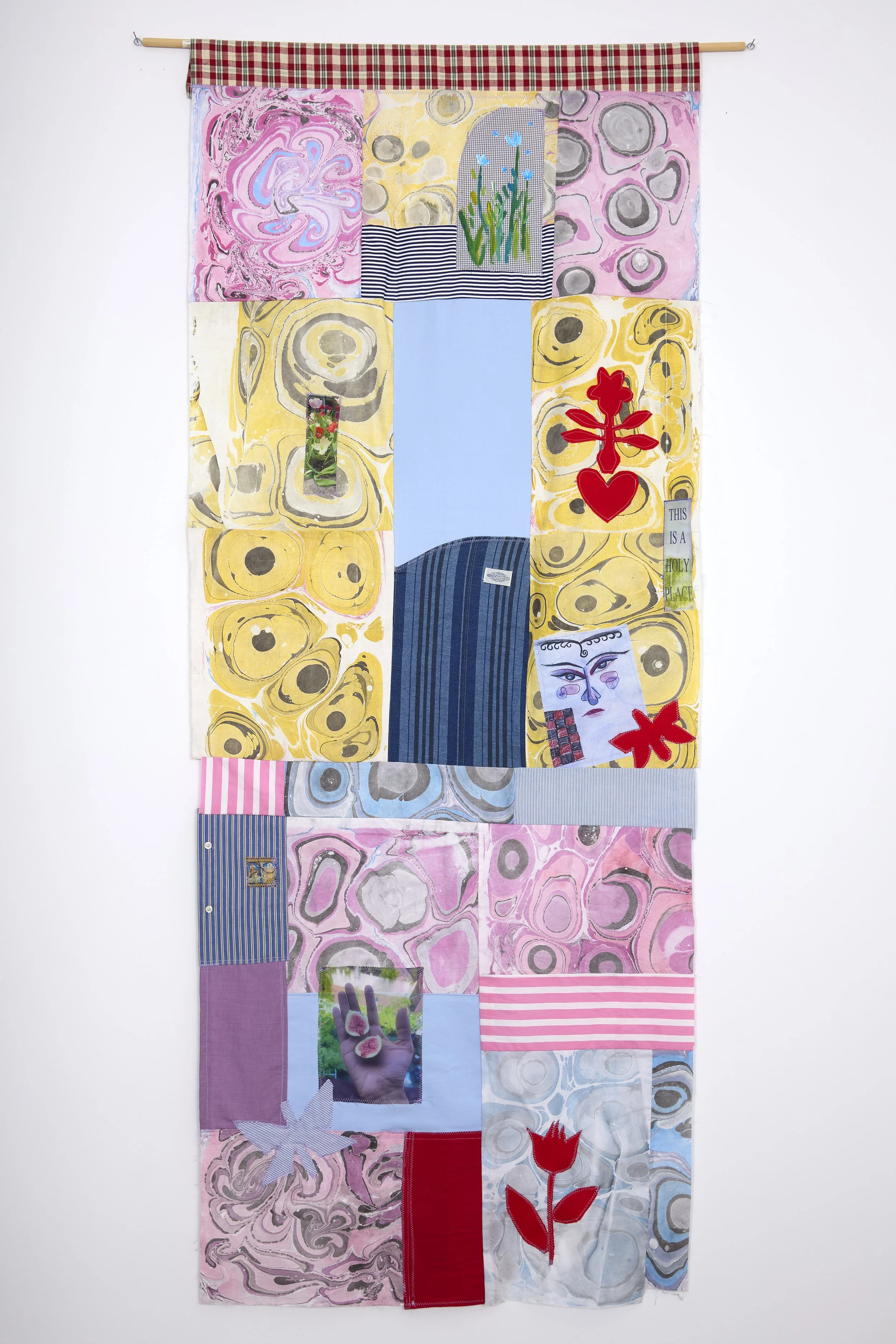
Aruni Dharmakirthi, MindStream I, 2026. Courtesy of artist and TEMPEST.
Anchoring the space are three hanging MindStream tapestries, a title borrowed from Buddhist philosophy. The concept of the mindstream (santāna) grasps consciousness as an ever-searching continuum extending across one life to the next, such that existence is a cycle without beginning or end. Our mind just continuously flows in the winding stream of the universe, always porous to transformation, always seeking further growth.
Memories from our past are imprinted unto us. The actions of our parents and our ancestors mark our consciousness, just as ours will mark those of future generations. Hopefully, we never come of age.