
Eva Tellier: The Overflow
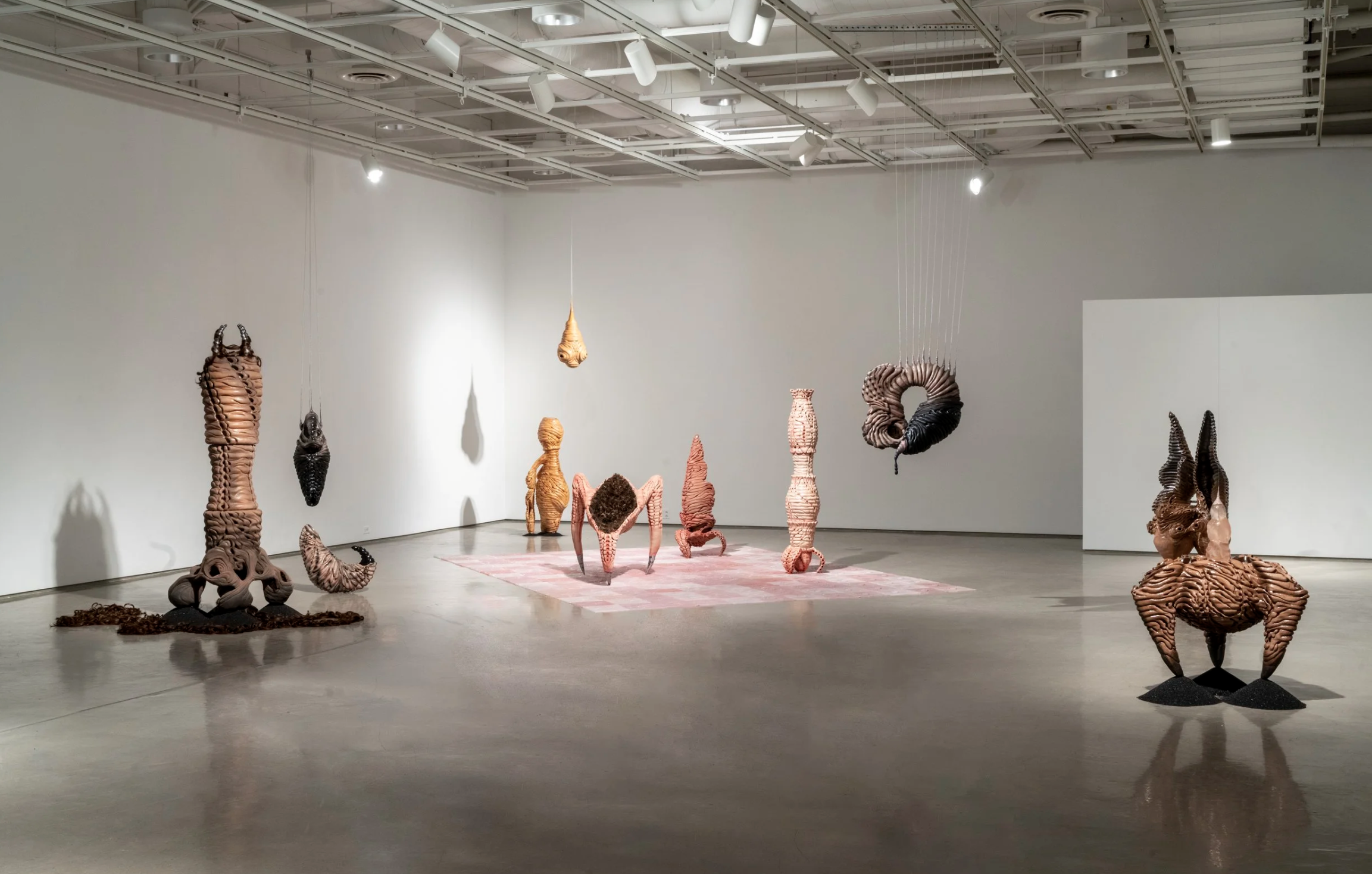
Installation view: ant/i/bodies, 2025. Ceramic, silicone, human hair, beeswax, rubber, cast aluminum, and sand blasting medium, Fosdick-Nelson Gallery, Alfred, New York.
In a high, vast, and empty distance
Where you can't see but Sierra stars
Eat them until you drift near me
I'll turn the light on so bright
Julia Holter, Turn the Light On, 2018
Eva Tellier creeps under my skin. Working with ceramic, she sculpts otherworldly forms drifting somewhere between primeval and futuristic, or fleshy and synthetic, usually presented as design objects. Her sculptures recall things found on earth—chairs, totems, insects, intestines—but in her hands they appear unnatural, alien even. This inversion of all things familiar, this unraveling of all things contained, is the great conceit of Tellier’s body of work.
My first encounter with Tellier was during her studio residency at the Museum of Arts and Design (MAD) in Midtown Manhattan. I visited her with my friend. There we saw several works featured in her MFA thesis exhibition, ant/i/bodies (2025), presented at Fosdick-Nelson Gallery in Alfred, NY. Parasitic entities standing nearly life-size on their feet. Some resembled vase-like cocoons, or pods, on the cusp of producing new life. Others resembled bees and spiders of giant size, as if displaced from some cosmic elsewhere. They were strangely inviting, familiar even, despite their mystique—uncanny, in the Freudian sense.
Tellier’s ceramics are sometimes compared to the work of artist Hans Ruedi Giger, known for his set designs for the science-fiction film (and franchise) Alien (1979). The affinity is undeniable. Both Tellier and Giger craft visual worlds that bridge the ancient and futuristic, informed by an interest in the biomechanical, with subtle nods to past traditions that are never entirely traceable. Giger never directly influenced Tellier, however. More than any cultural or aesthetic lineage, she situates her work within the gothic tradition, of which Alien is incidentally an outgrowth.
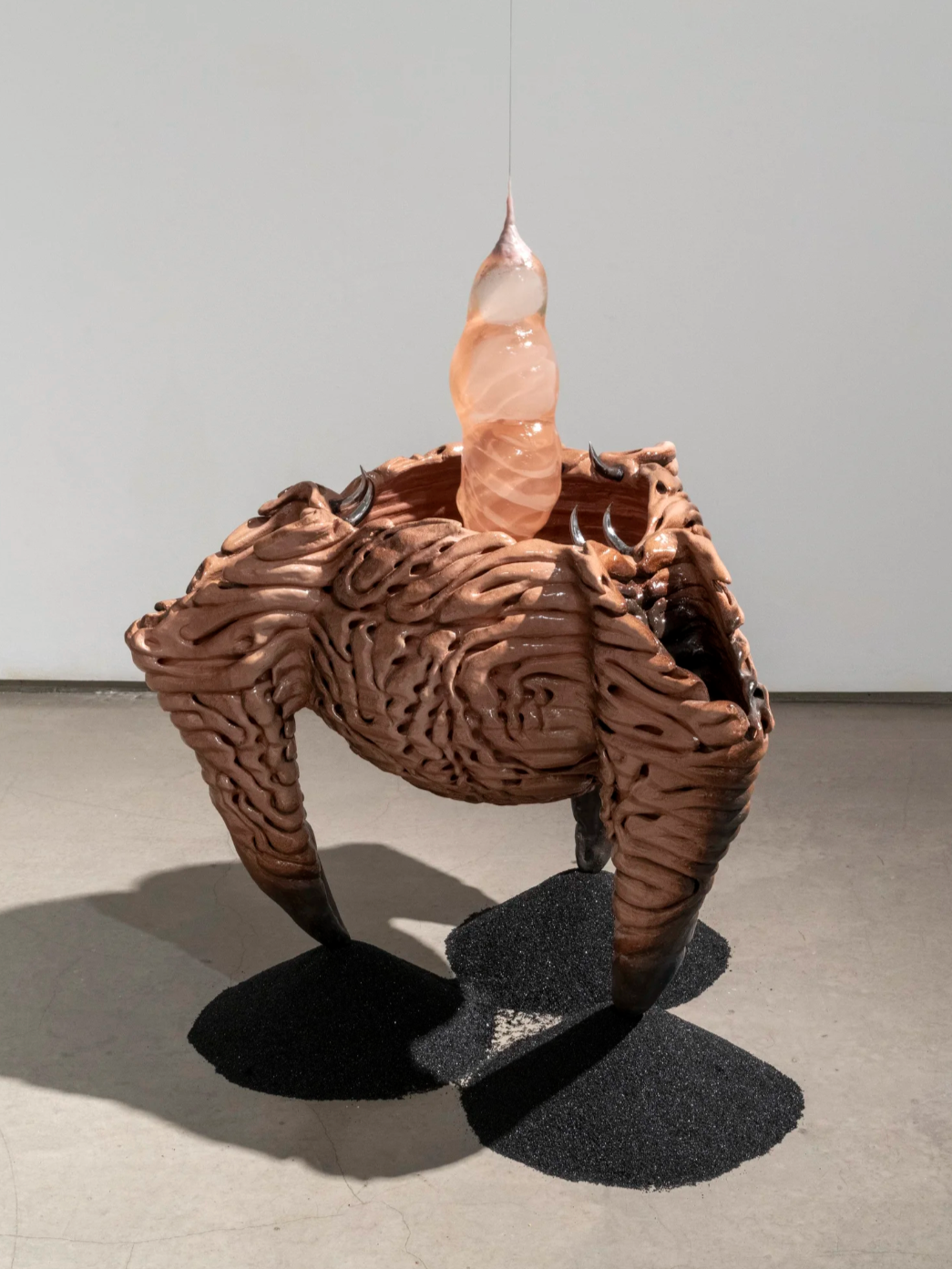
In the gothic, the sublime lurks beyond the valley, as beauty and terror, virtue and vice, dance in an enticing melodrama. While traditionally associated with the Victorian novel, the gothic can be viewed as a mode of cultural production, or a broad field of moral and aesthetic concerns which fluidly shapeshifts throughout time as the foundations of morality and aesthetics are rebuilt. The gothic extracts and interrogates society’s repressed waste, codified according to its temporal and cultural milieu. The horrors of Jane Eyre, or even Alien, might still resonate today, but likely won’t induce the terror they once did.
Tellier makes me wonder:
where is the gothic today?
If gothic horror manifested in the 1970s as an external terrorizer (as in Alien), today it manifests as a terror of the internal. It’s no longer about the terror of the outside seeping in, but about the dread of the parasitic otherness already within, dormant but corrosive. It goes beyond fear of the abject. It’s fear of biological processes and features that can’t be regulated, optimized, or muted, of the human body as unknowable. It’s gothic horror tailored for an age haunted by discourses around transhumanism, technological singularity, and looksmaxxing. Tellier’s ceramics illustrate this shift. They are not properly abject per se—she works with human hair, but not blood, urine, or saliva—nor are they terror-inducing. But they appear to be the repressive sheds of a society terrorized by bodily imperfection, like fleshy leftovers of a cosmetic surgery gone array.
It was no surprise when she mentioned being influenced by New French Extremity and body horror cinema—particularly Julia Ducournau, director of Raw (2016) and Titane (2021). Beyond the gore, Ducournau’s cinema is pure existentialism. Her characters always seek some form of spiritual transcendence, often attained through the body. Self-destruction and self-optimization converge, as if originating from the same root, producing some breakthrough. Tellier’s objects appear as mirror-images to Ducournau’s gothic mode. There is no external ill, but only the dread of the body as a self-consuming parasitic.
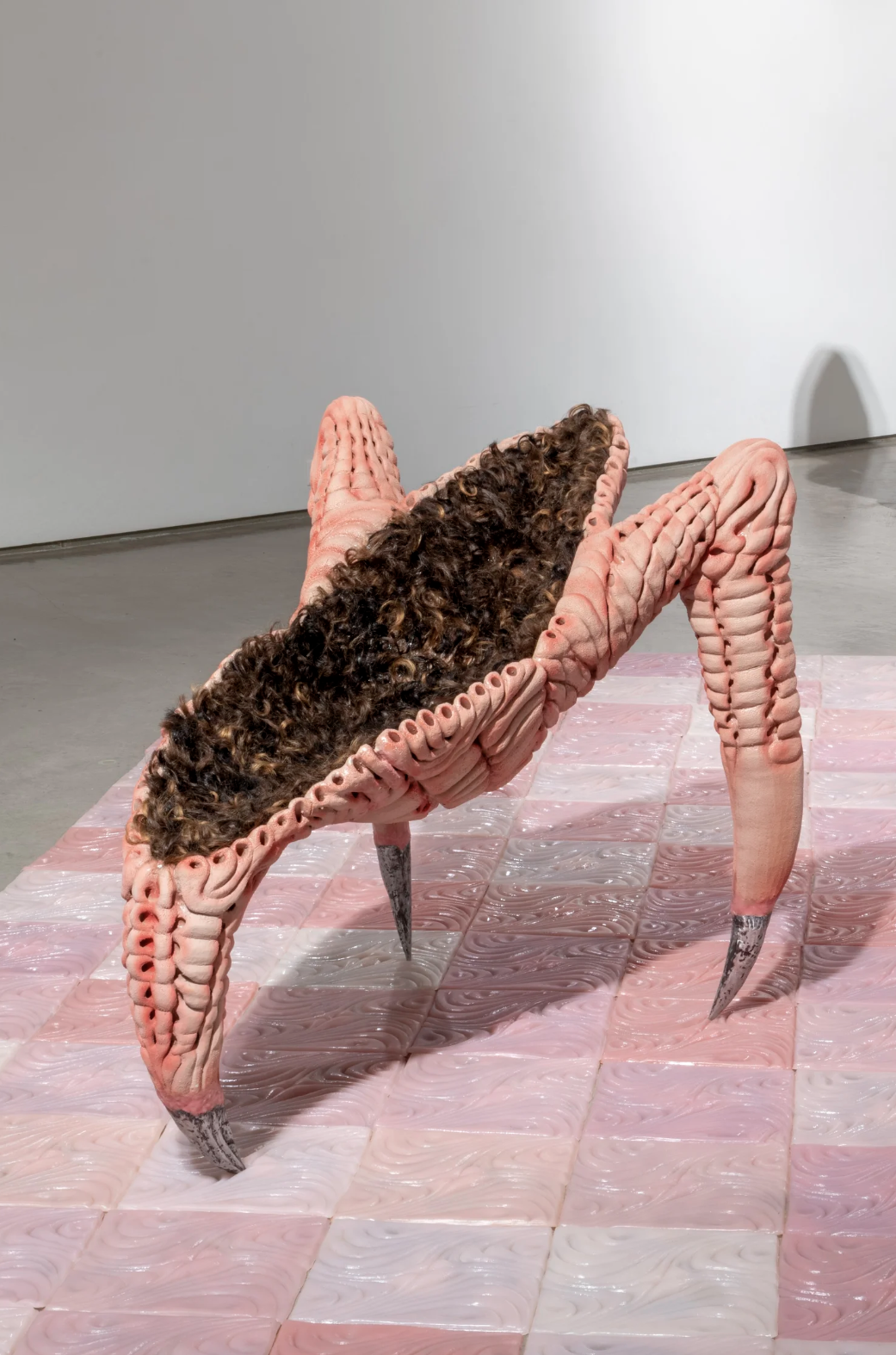
The hypnotic allure remains as you gaze into Chair et poil (Flesh and Fur) (2025), an urge to caress these pulpy surfaces; to sit in that hairy cradle; to indulge in the taboo. For Georges Bataille, another influence on Tellier, erotic transgression enacted a form of liberation, a holy, transcendent escape from the bound self. I like to think of these objects as transcendent entities: utopian bodies freed by transgression, the contemporary repressive adopting sublime form. They stand there, tempting you to join their orbit. Will you indulge? Will you, too, dare to overflow?
Few people read queerness in Tellier’s work—perhaps because the gothic is generally associated with the feminine abject and because there’s something of the monstrous-feminine in her ceramic language. But I think she also touches on queer horror—the queer subject as a fragmented entity confronted by their own otherness, internalizing their status as self-consuming parasites. Artists like Robert Gober or Félix González-Torres also attempted to express this queer existentialism through disembodiment, particularly in response to the HIV/AIDS crisis. However, Tellier takes that exploration into cosmic territory, paradoxically tapping into something more intimate.
It’s validating to know that Tellier also reads her work as queer, because as I enter her universe, I keep thinking back on my coming out. I was eighteen. Queer representation made me feel seen, but it did little to cure the sickness of internalized homophobia. I feel ashamed to admit I saw my queerness as a parasite eating away at me. Solace came with Julia Holter’s art pop album Aviary (2018), an otherworldly musical experience complete with celestial strings, thundering drums, and whimsical woodwinds, guided by Holter’s voice. Everything reverbs and breathes in this sonic cathedral, alternating between apocalyptic eruptions of noise and heavenly serenity, as if orchestrating the big-bang of a new universe. Aviary lent a sound to the cosmic horror of coming out. It finds the parasitic, the all-consuming, as a generative force. It’s a gift to encounter that quality in Tellier, something that so viscerally captures what it feels like to embody queerness.
Tellier and I never discussed this, but antibodies are a perfect metaphor for her art objects: auto-immune proteins produced to target and neutralize foreign objects contained within. An unfeeling process seeking to optimize the body by neutralizing its intrinsic foreignness. Creation through destruction. A sublime symphony. That’s what Ducournau, Holter, and Tellier have taught me: destroy everything and you’ll find yourself.